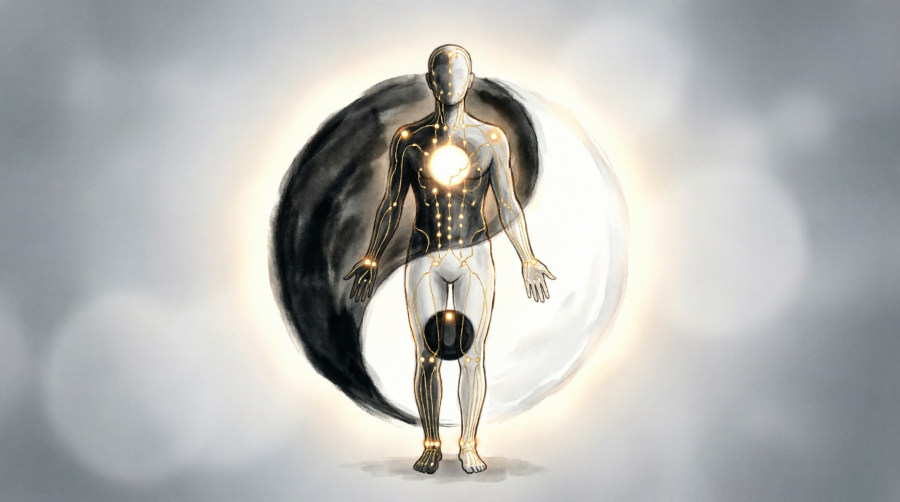
In the bustling rhythm of modern life, the concept of “balance” is often thrown around casually. We speak of work-life balance, balanced diets, or feeling “off-balance” when stressed. Yet, few frameworks explore this concept with as much depth and physiological precision as Traditional Chinese Medicine (TCM). At the heart of this ancient healing system lies a fundamental theory that has guided practitioners for thousands of years: Yin and Yang.
Often recognized by the familiar Taiji symbol—a swirl of black and white interlocking shapes—Yin and Yang are frequently misunderstood as simple opposites, like good versus evil. In reality, they represent something far more nuanced.
They are opposing yet complementary forces that exist in a constant state of flux. Just as day cannot exist without night, and heat cannot be understood without cold, Yin and Yang define each other. In the context of the human body, they are the lens through which TCM views vitality, function, and structure.
The central thesis of this philosophy is straightforward yet profound: health is not merely the absence of disease, but the dynamic equilibrium of Yin and Yang. When these forces are harmonious, the body thrives. When they are disrupted—whether one becomes too dominant or too weak—illness arises. This imbalance manifests not just as vague discomfort, but as specific patterns of symptoms that signal where the body’s energy has gone astray.
In this article, we will delve into the core dynamics of Yin and Yang. We will explore the philosophical foundations of these forces, map them to specific physiological functions within the human body, and examine how imbalances lead to disease.
Finally, we will identify the tangible symptoms of Yin and Yang disorders, empowering you to recognize the signs of imbalance and understand the principles behind restoring harmony to your health.
The Philosophy of Opposing Yet Complementary Forces
To understand how Yin and Yang apply to human health, we must first grasp them as a philosophical framework. In Taoist thought, Yin and Yang are not static objects or materials; they are descriptors of relationships and processes. They explain how the universe organizes itself through change. This relationship is governed by four core characteristics that describe how these forces interact.
The Four Core Characteristics
1. Opposition At their most basic level, Yin and Yang are opposites. They constrain and control each other. If Yang represents heat, Yin represents cold. If Yang represents movement, Yin represents stillness.
This opposition is not a conflict to be won, but a necessary tension that creates stability. Without the opposing force of cold, heat would consume everything; without the constraint of stillness, movement would become chaos.
2. Interdependence While they oppose each other, Yin and Yang are utterly reliant on one another for existence. There is no concept of “up” without “down,” and no concept of “light” without “shadow.” In philosophical terms, Yin is often seen as the material aspect (the substance), while Yang is the functional aspect (the energy). You cannot have a function without a substance to perform it, and substance is useless without the energy to animate it. They define each other.
3. Mutual Consumption Balance between Yin and Yang is not a fixed 50/50 split; it is a dynamic equilibrium. This is described as mutual consumption. As one aspect grows, the other naturally recedes. Consider a 24-hour cycle: as the day (Yang) progresses toward noon, the night (Yin) recedes.
As night falls, the day diminishes. In a healthy system, this ebb and flow is smooth. Problems arise only when one side grows too dominant without the natural check of the other, or if one side fails to grow when it is supposed to.
4. Transformation Under specific conditions, Yin and Yang can transform into one another. This usually happens at the extreme end of a cycle. In the natural world, this is seen when the coldest point of winter (Extreme Yin) eventually gives way to the warmth of spring (Yang).
In the body, this might be observed when a high fever (Extreme Yang) leads to a sudden collapse and coldness (Yin). This principle reminds us that nothing is permanent; all states are transient and capable of shifting.
Universal Analogies
Because TCM views humans as microcosms of the universe, the laws that govern nature also govern the body. We can see the dance of Yin and Yang everywhere around us:
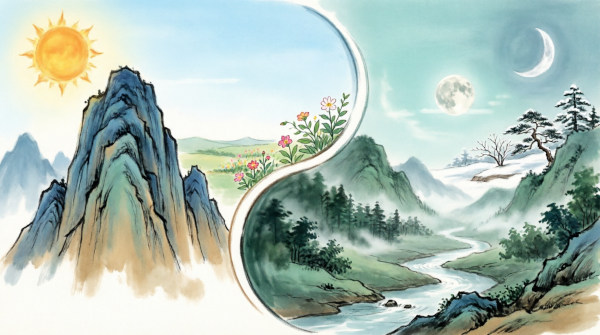
- Nature: Imagine a landscape. The mountain, rising toward the sun and exposed to the light, is Yang. The valley, shaded and holding water, is Yin. Both are part of the same earth, yet they possess different qualities.
- Time: The cycle of day and night is the clearest example. The daylight hours, filled with activity and light, are Yang. The night, reserved for rest and darkness, is Yin. A healthy life respects this rhythm, being active during the Yang hours and resting during the Yin hours.
- Season: The year breathes in and out. Summer, with its expansion, heat, and outward energy, is the peak of Yang. Winter, with its contraction, cold, and storage of energy, is the peak of Yin. Spring and Autumn serve as the transitional phases where transformation occurs.
By observing these natural cycles, we understand that balance is not about staying in one state forever. It is about flowing with the changes. Just as a tree would die if it tried to bloom in winter, the human body suffers when it forces Yang activity during Yin times. Having established these universal laws, we can now look inward to see how they map onto our own physiology.
Yin and Yang Within the Human Body
Having explored the broader principles of Yin and Yang, we now turn inward. In Traditional Chinese Medicine (TCM), the human body is viewed as a microcosm of the natural world. The same patterns that describe cycles in nature are used as a framework to understand human physiology.
However, instead of mountains and seasons, this framework is applied to processes such as circulation, energy production, organ function, and metabolism. Understanding how these ideas map onto the body helps explain how TCM interprets health and imbalance.
Physiological Mapping: Structure and Function
To simplify the body’s complexity, TCM broadly groups physiological processes into two categories: structure (Yin) and function (Yang).
Yin: The Material Foundation
Yin refers to the physical and nourishing aspects of the body—the components that provide structure and support.
- Components: These include blood, body fluids (such as saliva, sweat, and digestive fluids), and the internal organs (often referred to in TCM as the Zang organs, such as the Heart, Liver, and Kidneys—concepts that do not always correspond exactly to Western anatomical definitions).
- Qualities: Yin is associated with cooling, moistening, and stabilizing functions. It provides the material basis for physiological activity. A useful analogy is oil in a lamp—it sustains the flame. When Yin is insufficient, the body may be described (in TCM terms) as becoming dry, overheated, or depleted.
Yang: The Functional Activity
Yang refers to the body’s activity, energy, and processes—the functions that keep systems moving and transforming.
- Components: These include Qi (often translated as “vital energy”), metabolic activity, digestion, movement, warmth, and protective functions (such as what TCM calls Wei Qi, loosely comparable to aspects of immune defense).
- Qualities: Yang is associated with warming, activating, and stimulating functions. It drives circulation, digestion, and mental activity. In the lamp analogy, Yang is the flame—it provides heat and light, but depends on the oil (Yin) to continue burning. When Yang is insufficient, the body may feel cold, fatigued, or less responsive.
These two aspects are interdependent. For example, physical substances (Yin) require functional activity (Yang) to circulate and transform, while activity depends on adequate material support. In clinical practice, TCM practitioners assess the relative state of both.
The Goal of Homeostasis: Dynamic Balance
A common misconception is that balance means a fixed, unchanging state. In reality, both modern physiology and TCM recognize that health depends on adaptability. In TCM terms, this is described as a dynamic balance between Yin and Yang.
The goal is not to keep Yin and Yang equal at all times, but to allow them to shift appropriately in response to changing conditions. This fluid balance is similar to what modern medicine describes as homeostasis.
- Activity Levels: During exercise, metabolic activity and heat production (Yang) increase. Afterward, restorative processes (Yin) help cool the body and repair tissues.
- Time of Day: During the day, alertness and activity (Yang) are more prominent. At night, restorative and regenerative processes (Yin) take precedence.
- Seasons: In warmer months, the body tends toward more outward activity and heat regulation (Yang). In colder months, it conserves energy and maintains internal warmth (Yin).
Health can be viewed as the ability to adapt smoothly to these shifts. When this adaptability is impaired—for example, difficulty sleeping at night or poor recovery after exertion—symptoms may arise.
With this foundation in place, we can now examine how disruptions in this balance are interpreted within TCM.
How Imbalance Leads to Illness
If health is understood as a dynamic balance, then illness can be seen as a disruption of that balance. In TCM, disease is described as a shift in the relationship between Yin and Yang, rather than a single isolated cause. This framework does not replace modern biomedical explanations, but offers an additional way of interpreting patterns of symptoms.
When balance is disrupted—whether through deficiency (insufficient support) or excess (overactivity or accumulation)—the body’s ability to regulate itself may be affected.
The Four Primary Patterns of Imbalance
1. Yin Deficiency (Relative Heat)
This pattern describes a relative lack of the body’s cooling and nourishing components. Because Yin normally controls and cools Yang, a lack of Yin allows Yang to become relatively hyperactive.
- The Mechanism: A useful comparison is an engine with insufficient coolant. Even normal activity can lead to overheating when regulation is reduced.
- The Result: Symptoms are interpreted as signs of “heat,” not necessarily due to excess heat production, but due to reduced cooling capacity.
2. Yang Deficiency (Relative Cold)
This pattern arises when the warming, motivating energy of the body is weak. Without sufficient Yang, the body cannot perform its metabolic functions effectively, and Yin (coldness) becomes relatively dominant.
- The Mechanism: Think of a house in winter where the furnace is failing. The cold outside (Yin) isn’t necessarily stronger than usual, but because the heat source (Yang) is weak, the house becomes cold.
- The Result: The body may present signs associated with “cold,” such as low energy or reduced metabolic activity.
3. Yin Excess (Accumulated Cold or Dampness)
Unlike Yin Deficiency, this is an actual accumulation of pathogenic cold or dampness in the body. This refers to an accumulation that slows or obstructs normal function.
- The Mechanism: This is like pouring ice water into the engine. The coolant system is overwhelmed by actual cold substance, freezing the mechanics.
- The Result: Symptoms are associated with stagnation, heaviness, or reduced movement.
4. Yang Excess (Excess Heat or Overactivity)
This pattern occurs when there is an actual invasion of pathogenic heat or an overactivity of function that consumes body fluids.
- The Mechanism: This is like pouring gasoline on a fire. The heat is real, intense, and excessive.
- The Result: Symptoms may resemble fever, agitation, or increased physiological activity.
Causes of Imbalance
What causes these shifts in the first place? TCM identifies three main categories of factors that disrupt Yin and Yang harmony.
External Factors (Environmental Influences)
The body is constantly interacting with the environment. While normal weather is harmless, extreme or sudden changes can become pathogenic.
- Examples: Prolonged cold exposure may impair warming functions (damage Yang), while excessive heat may contribute to dehydration or overheating (consume Yin). In TCM, infectious illnesses are often described using environmental metaphors such as “Wind-Heat” or “Wind-Cold.”

Internal Factors (Emotional Stress)
Emotions are seen as powerful energetic forces. When experienced moderately, they are normal; when suppressed or experienced excessively, they damage specific organs and Qi flow.
- Examples: Ongoing stress or anger may be associated with increased tension or elevated physiological arousal. Excessive worry or mental strain may affect digestion or energy levels. Fear or prolonged stress may contribute to fatigue or reduced resilience.
Lifestyle Factors (Daily Habits)
Perhaps the most common cause of imbalance in the modern world stems from daily habits that slowly erode the body’s reserves.
- Diet: Consuming too much raw, cold food can damage Yang. Eating too much spicy, greasy food can generate Heat (Yang Excess).
- Sleep: Staying up late consumes Yin, as night is the time for Yin restoration.
- Workload: Physical overexertion can lead to fatigue (consumes Yang), while prolonged mental strain or lack of recovery can reduce overall resilience.
By identifying patterns of imbalance and contributing factors, TCM aims to understand the broader context of illness. While this framework differs from modern biomedical models, it can offer a complementary way of recognizing patterns in the body.
In the next section, we will focus on the practical side—how these imbalances present as recognizable symptoms, and how to identify whether the body may be signaling a need for rest, nourishment, cooling, or activation.
Identifying the Signs: Symptoms of Yin and Yang Imbalances
Understanding the theory of Yin and Yang is important, but its practical value lies in how it is applied. In Traditional Chinese Medicine (TCM), practitioners use this framework to identify patterns of imbalance that may help explain clusters of symptoms. For both practitioners and health-conscious individuals, recognizing these patterns can offer insight into how the body may be functioning out of balance.
A key distinction in TCM is between deficiency (insufficient support or resources) and excess (overactivity, accumulation, or obstruction). These patterns guide different approaches: deficiencies are typically addressed by supporting or replenishing the body, while excess patterns focus on reducing or clearing what is overwhelming the system.
Below are the characteristic signs associated with the four primary imbalance patterns.
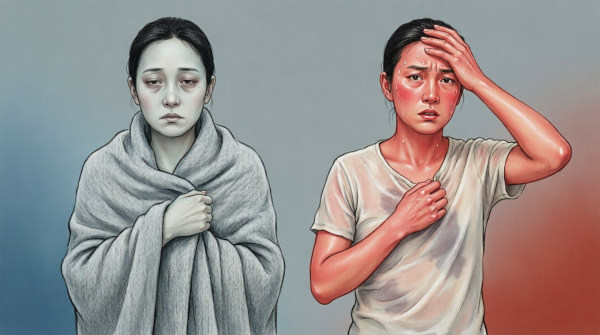
1. Yang Deficiency (The “Relative Cold” Pattern)
When Yang-related functions (such as metabolic activity and warmth) are reduced, the body may have difficulty maintaining energy and temperature.
- Sensation: A persistent feeling of cold, especially in the hands and feet. This is often described as an internal cold that is not easily relieved by external warmth. There is typically a strong preference for warm environments, foods, and drinks.
- Energy: Low energy levels are common, including fatigue, lethargy, and reduced motivation. The voice may be soft or weak.
- Physical Signs: The complexion may appear pale. Digestion and fluid metabolism may be slower, which can present as loose stools or increased urination that is clear in color.
- Clinical Observations (TCM): In TCM assessment, this pattern is often associated with a pale, moist tongue and a slower, deeper pulse.
2. Yin Deficiency (The “Relative Heat” Pattern)
When the body’s cooling and nourishing components are insufficient, there may be signs of relative overheating or overstimulation.
- Sensation: Heat-related sensations tend to be more noticeable at specific times, such as evening or night. Common descriptions include night sweats, warm palms and soles, or a feeling of internal heat.
- Energy and Mental State: Restlessness, difficulty relaxing, and sleep disturbances—particularly waking during the night—are common. People often describe feeling “tired but unable to switch off.”
- Physical Signs: Dryness is a key feature, including dry skin, throat, or eyes. Urine may be darker and more concentrated, and constipation may occur.
- Clinical Observations (TCM): This pattern is often associated with a red tongue with reduced coating and a thinner, faster pulse.
3. Yang Excess (The “Excess Heat” Pattern)
This pattern reflects heightened activity in the body, often resembling acute inflammatory or feverish states.
- Symptoms: Signs tend to be intense and more sudden in onset. These may include high fever, strong thirst (often with a preference for cold drinks), flushed skin, and irritability. In more severe cases, agitation or confusion may occur.
- Digestive Effects: Constipation and dry stools are common, as increased heat may reduce fluid availability.
- Distinction: Compared to Yin deficiency, this pattern is typically more acute and pronounced. It reflects a stronger, more active process rather than a gradual depletion.
4. Yin Excess (The “Excess Cold or Damp” Pattern)
This pattern involves accumulation or stagnation that slows down normal function.
- Symptoms: Individuals may experience pronounced chills and a sensation of heaviness in the body. This can feel like sluggishness or physical burden.
- Fluid Retention: Swelling (edema), especially in the lower limbs, and increased mucus or phlegm (often clear or white) may be present.
- Pain and Discomfort: Discomfort may feel fixed or localized and can worsen in cold or damp conditions.
- Distinction: Unlike Yang deficiency (which reflects reduced activity), this pattern involves a more substantial obstruction or accumulation that interferes with normal processes.
Summary of Diagnostic Signs
| Pattern | Nature | Key Sensation | Energy Level | Tongue | Pulse |
| Yang Deficiency | Empty Cold | Internal Cold, Cold Limbs | Low, Lethargic | Pale, Wet | Deep, Slow |
| Yin Deficiency | Empty Heat | Night Sweats, Hot Palms | Restless, Insomniac | Red, No Coating | Thin, Rapid |
| Yang Excess | Full Heat | High Fever, Severe Thirst | Agitated, Intense | Red, Yellow Coating | Full, Rapid |
| Yin Excess | Full Cold | Severe Chills, Heavy Body | Stagnant, Sluggish | Pale, Sticky Coating | Tight, Slow |
Recognizing these patterns can help frame how different symptoms may be connected. However, interpretation within TCM is individualized, and similar symptoms may arise from different underlying patterns.
Identifying an imbalance is only the first step. The next stage involves understanding how to respond—through lifestyle adjustments, diet, and, where appropriate, professional guidance.
In the next section, we will explore general treatment principles and practical strategies used to support balance between Yin and Yang.
Restoring Balance: Treatment Principles
Once a pattern of imbalance has been identified—whether it involves reduced functional activity, insufficient nourishment, or an accumulation of stressors—the goal is to restore a functional balance between Yin and Yang.
In Traditional Chinese Medicine (TCM), this process focuses not only on relieving symptoms, but also on addressing underlying patterns contributing to them. This approach is often described as “treating the root.”
The TCM Approach: Addressing the Underlying Pattern
The strategy used depends on the type of imbalance identified. Broadly, approaches fall into two categories, reflecting the Yin–Yang framework:
- Support and Nourish (for Deficiency patterns):
When the body lacks sufficient resources or functional capacity, the aim is to strengthen or replenish it.- For Yin Deficiency: The focus is on supporting hydration, cooling, and restorative processes.
- For Yang Deficiency: The focus is on improving warmth, energy levels, and metabolic activity.
- Reduce or Clear (for Excess patterns):
When there is overactivity, accumulation, or obstruction, the goal is to reduce or regulate it.- For Yang Excess: The aim is to reduce excess heat or overstimulation.
- For Yin Excess: The aim is to address accumulation (such as fluid retention or sluggish processes) and restore movement.
Applying the wrong approach may aggravate symptoms. For example, stimulating or heating strategies in someone already experiencing signs of excess heat or overstimulation may worsen discomfort. For this reason, individualized assessment is central to TCM practice.
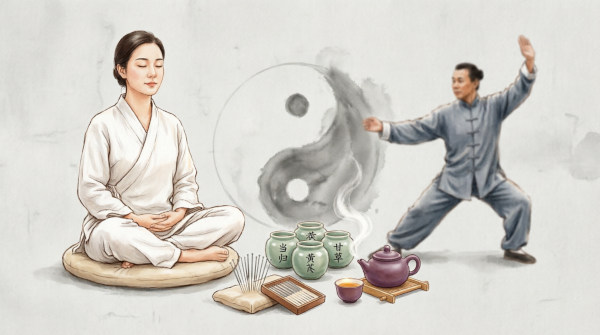
Modalities for Supporting Balance
TCM uses a range of approaches, often in combination, to support the body’s regulatory systems. Many of these can be viewed as complementary to modern health practices.
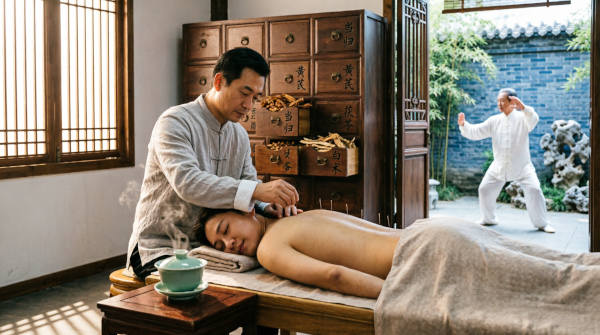
1. Acupuncture: Acupuncture involves the insertion of fine needles into specific points along the body’s meridians (energy channels).
- Function: It is used to influence nervous system activity, circulation, and pain modulation, and in TCM terms, to regulate the flow of Qi and Blood.
- Application: Depending on the pattern, techniques may aim to stimulate underactive systems or calm overactive ones.
- In some cases, moxibustion (the warming of points using heated herbal material) is used to promote warmth and circulation.
- In other cases, treatments may focus on calming or regulating overactivity without adding stimulation.
2. Herbal Medicine: Traditional herbal formulas are tailored to the individual and are selected based on observed patterns.
- Function: Herbs are categorized in TCM by their perceived energetic properties (such as warming or cooling) and are used to support balance.
- Application (conceptual examples):
- Warming herbs (e.g., ginger or cinnamon) are traditionally used to support circulation and warmth.
- Cooling or nourishing herbs (e.g., goji berry or rehmannia) are used to support hydration and restorative processes.
- Clearing herbs are used in cases of excess heat or inflammation.
(Note: In a Western context, herbal use should be guided by qualified professionals due to variability in safety, quality, and interactions with medications.)
3. Dietary Therapy
In TCM, diet plays a central role in maintaining balance. Foods are viewed not only in terms of nutrients, but also their overall effect on the body.
- Function: Daily eating habits provide a consistent way to support or rebalance physiological function.
- Application:
- For low energy or cold sensitivity (Yang Deficiency): Emphasis is placed on warm, cooked foods (such as soups, stews, and cooked vegetables).
- For signs of heat or dryness (Yin Deficiency): Emphasis is placed on hydrating, less processed foods (such as fruits, vegetables, and lighter meals).
- For excess patterns: Reducing highly processed, greasy, or overly rich foods may help support digestion and metabolic balance.
These principles often align with general nutritional advice focused on whole, balanced diets.
4. Lifestyle and Daily Habits: Long-term balance is strongly influenced by daily routines and stress levels. Many recommendations in TCM align with widely accepted health practices.
- Sleep: Adequate sleep supports recovery, hormonal regulation, and cognitive function. Consistent sleep schedules are generally encouraged.
- Movement Practices: Activities such as Qigong or Tai Chi combine gentle movement with breathing and mental focus. These practices may support mobility, relaxation, and stress reduction.
- Stress Management: Chronic stress affects multiple body systems. Techniques such as mindfulness, relaxation exercises, and structured downtime can help support overall balance.
By combining these approaches, TCM aims to support the body’s ability to regulate itself rather than focusing solely on symptom relief. While this framework differs from conventional Western medicine, many of its practical recommendations—such as improving sleep, diet, and stress management—overlap with modern preventive health strategies.
Achieving and maintaining balance is not a one-time intervention, but an ongoing process shaped by daily habits and environmental influences.
Curious to learn more about Traditional Chinese Medicine? 📚
Explore a selection of beginner-friendly and in-depth TCM books and start deepening your understanding today.👉
End Words
The philosophy of Yin and Yang offers more than a symbolic image of black and white swirls; it provides a structured way to think about balance in the body. Throughout this article, we have explored how these complementary forces can be used to interpret patterns in both nature and human physiology.
Within this framework, health is not viewed as a fixed state, but as an ongoing process involving the balance between structure and function, rest and activity, cooling and warming processes.
Understanding these principles can help you engage more actively with your own well-being. Rather than seeing symptoms as isolated or random, you can begin to observe patterns. For example, persistent coldness and low energy may point toward reduced metabolic activity, while restlessness and dryness may suggest insufficient recovery or hydration.
Recognizing these tendencies early can support more informed lifestyle choices—such as adjusting sleep, nutrition, and activity levels—before issues become more pronounced.
At its core, the idea of Yin and Yang emphasizes adaptability. Life is constantly changing, and the body must continuously adjust to internal and external demands. Maintaining health, therefore, is less about reaching a perfect state and more about responding appropriately to change.
Some periods call for increased activity and output, while others require rest and restoration. Supporting this natural rhythm is a key aspect of long-term well-being.
A Note on Professional Care
While the Yin–Yang framework can offer useful perspective, it is important to view it as complementary to modern medical understanding. This information is intended for educational purposes and is not a substitute for professional medical advice, diagnosis, or treatment.
If you are experiencing ongoing or concerning symptoms, it is important to consult a qualified healthcare provider. If you are interested in Traditional Chinese Medicine, seek out a licensed practitioner who can provide individualized guidance.
By incorporating these principles into daily life—alongside evidence-based healthcare—you can develop a more balanced and responsive approach to well-being, supporting resilience in the face of everyday challenges.
References & Further Reading
- World Health Organization. (2022). WHO International Standard Terminologies on Traditional Chinese Medicine.
- Tang, J. L., et al. (2008). Traditional Chinese Medicine. The Lancet, 372(9654), 1938-1940.
- Yang, G., et al. (2025). Yin-yang in Modern Traditional Chinese Medicine. Journal of Traditional Chinese Medicine Sciences.
- Smith, H. F., & Laitman, J. (2023). The Yin, Yang, and Anatomy of Traditional Chinese Medicine. The Anatomical Record.
- Li, Y., et al. (2022). Progress in the Study of Yang-Deficiency Constitution. PMC.
- Maciocia, G. (2015). The Foundations of Chinese Medicine (3rd ed.). Churchill Livingstone. (Aff.Link)
- National Center for Complementary and Integrative Health. (2023). Traditional Chinese Medicine: In Depth.
- Szeto YT, Benzie IF. Is the yin-yang nature of Chinese herbal medicine equivalent to antioxidation-oxidation? J Ethnopharmacol. 2006
- Yin-yang in modern traditional Chinese medicine: From mechanisms to digital innovation. Guanhu Yang and Tong Pu and Fengxing Tao and Xiaomin Quan and Kai Cheng.
*Note: This article is for educational purposes. Consult a licensed TCM practitioner or healthcare provider for personal medical advice.*
Stay in Touch
 Join our newsletter by using the forms on this website or click here!
- Follow us on Google News
- Follow us on Facebook