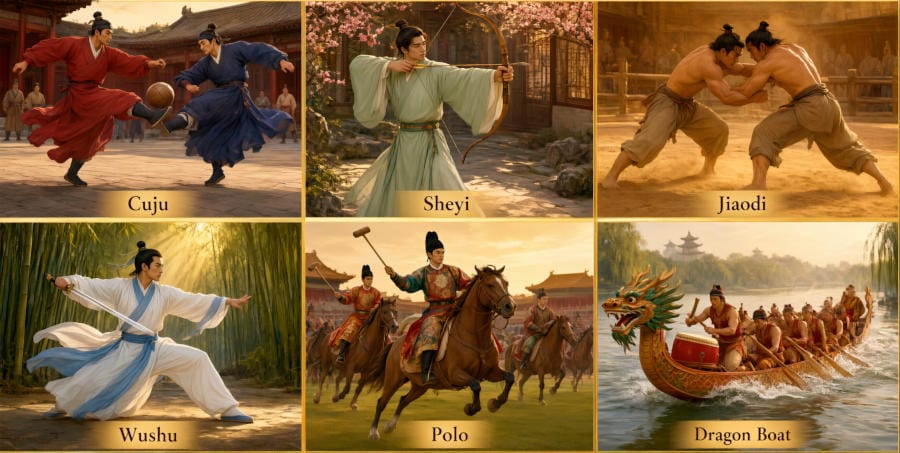
Picture a leather ball struck through a silk net in a Han Dynasty courtyard. A few centuries later, mounted players race across a Tang Dynasty polo field, while on a river in southern China, rowers pull together to the beat of a drum. These scenes belong to the same story: a long Chinese sporting tradition in which competition was never only about winning.
Sports in the history of China grew out of practical needs and spiritual beliefs. Hunting and combat demanded strength and precision. Rites required correct posture, self-control, and a sense of hierarchy. Seasonal festivals called for music, movement, and collective effort. Over time, these activities became games—and those games became a way for people to understand what a well-ordered life should look like.
Archery offers the clearest example. For the educated elite of the Zhou world, shooting well was not simply a matter of hitting a target. The ritual contest, known as sheyi, tested composure and conduct as much as marksmanship, which is why archery earned a place among the Six Arts of a gentleman. Cuju, a kicking game played with a leather ball, moved in a different direction: from military drill toward organized urban recreation, eventually attracting professional players and paying crowds.
Not every tradition began within China’s borders. Polo reached Chinese courts through contact with Central Asia and flourished under the Tang, where even women played. Dragon boat racing, meanwhile, grew from river customs in the south before acquiring the enduring association with the poet Qu Yuan. Wrestling known as jiaodi and the many martial lineages later gathered under the name wushu connected physical training with ideas about discipline, health, and self-defense.
Reading this history also means separating fact from attractive legend. Chinese sports have often been traced to mythical emperors or famous battles, but written records, excavated objects, and tomb art give us firmer ground to stand on. Equally important, many practices familiar today were reshaped—or formally standardized—much later. Modern competitive wushu, for instance, is a twentieth-century development built on far older traditions.
What follows traces those roots through the games themselves: how they were played, who played them, and what they reveal about the societies that made them possible.
Cuju: The Ancient Ancestor of Modern Football
Long before the modern football pitch was drawn, ancient China had Cuju (蹴鞠). The name itself reveals the mechanics of the game: cu means “to kick,” and ju refers to a leather ball. Recognized by FIFA as the earliest known form of football, Cuju offers a fascinating glimpse into how a practical military drill evolved into a sophisticated, widely beloved national sport.
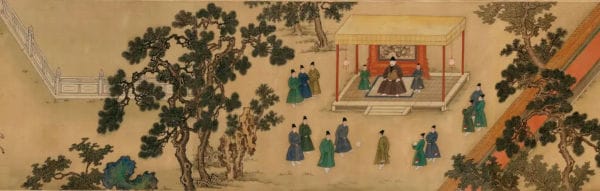
The earliest reliable written records of Cuju date back to the Warring States period (475–221 BCE). The historical text Zhan Guo Ce (Strategies of the Warring States) notes that the citizens of Linzi, the capital of the State of Qi, were so fond of the game that it was played regularly in the streets.
However, its primary early function was martial. Military commanders used Cuju to build physical stamina, agility, and teamwork among soldiers, transforming a recreational activity into a vital tool for battlefield readiness.
During the Han Dynasty (206 BCE–220 CE), the game became highly formalized. The Han court established standardized rules and constructed dedicated, enclosed playing fields known as jucheng (鞠城).
These fields featured six crescent-shaped goals on each side, resembling small holes or nets. While it remained a staple of military training, Cuju also gained immense popularity among the nobility and the imperial court, with several Han emperors recorded as avid players and patrons of the sport.
The true golden age of Cuju arrived during the Tang (618–907 CE) and Song (960–1279 CE) dynasties, marked by a crucial technological innovation: the invention of the air-filled ball. Earlier balls were solid, typically stuffed with feathers or animal hair, making them heavy and difficult to control. The Tang Dynasty introduced a lighter, hollow ball made of eight stitched leather panels and inflated with air. This upgrade made the game faster, higher-flying, and far more dynamic, shifting the focus from brute force to skill and finesse.
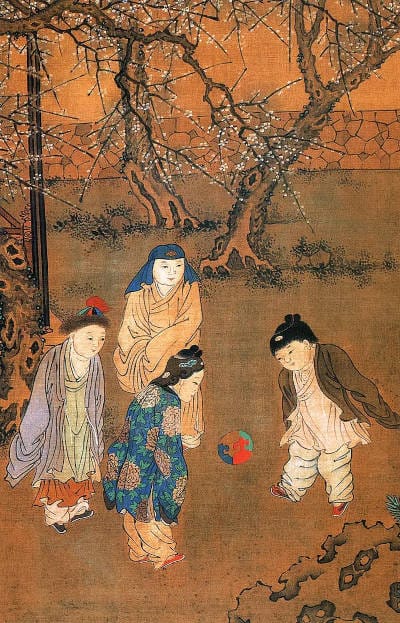
By the Song Dynasty, Cuju had transformed into a highly organized civilian sport. It was no longer confined to the military or the palace; it was played by merchants, artisans, and even women. The era saw the rise of professional Cuju organizations, most notably the Qiyun She (齐云社, or “Round Cloud Society”).
These guilds set strict professional standards, organized national tournaments, and even published rulebooks. The gameplay also evolved, with the most popular format becoming baida (白打), a freestyle performance where players kept the ball in the air using various body parts without it touching the ground, judged on technique and elegance rather than scoring goals.
The cultural footprint of Cuju is immortalized in classical Chinese literature and art. It is vividly described in Meng Yuanlao’s Dongjing Meng Hua Lu (The Dream of Hua in the Eastern Capital), which details the bustling Cuju culture of the Song capital, and depicted in numerous classical paintings showing children and adults alike engrossed in the game.
Today, Cuju’s legacy is securely anchored in both Chinese heritage and global sports history. In 2004, FIFA officially recognized the ancient city of Linzi in Shandong Province as the birthplace of football, validating what Chinese historical records have stated for over two millennia. Cuju stands as a powerful testament to China’s early contributions to global athletic culture, blending physical prowess with artistic expression.
Archery (Sheyi): The Art of Moral Cultivation
In the ancient world, a bow and arrow were primarily tools of war and hunting. Yet, in early China, the act of drawing a string and releasing a shaft was elevated into a profound philosophical practice. Known as Sheyi (射艺), traditional archery became a mirror for the soul, transforming a lethal martial skill into a rigorous discipline of moral and physical self-cultivation.
During the Western Zhou Dynasty (1046–771 BCE), archery was formalized as one of the “Six Arts” required for the education of a nobleman. Alongside rites, music, charioteering, calligraphy, and mathematics, archery was deemed essential for developing a well-rounded character.
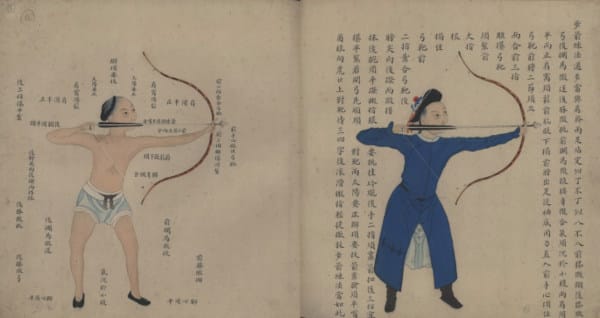
However, the ultimate goal was never merely to hit a physical target. Confucian philosophy deeply influenced this practice, teaching that true archery was an expression of inner virtue. A famous Confucian maxim states that when an archer misses the mark, he does not blame his opponent or his equipment; instead, he turns inward to seek the cause within himself.
This philosophy was put into practice during the highly choreographed “Grand Archery” (Dashe) ceremonies held in the imperial court. These events were far more than sporting competitions; they were sacred rituals designed to reinforce social hierarchy and cosmic harmony.
Archers were required to shoot in perfect synchronization with the rhythm of court music. The physical posture, the calmness of the mind, and the grace of the movements were judged just as strictly as the accuracy of the shot. To shoot well, one had to achieve a state of mental stillness and physical alignment, proving that their inner moral rectitude matched their outward composure.
Because of this deep connection between physical action and inner character, archery tournaments served a vital political and social function. Rulers and ministers used these ceremonies to observe the behavior, temperament, and integrity of their peers and subordinates.
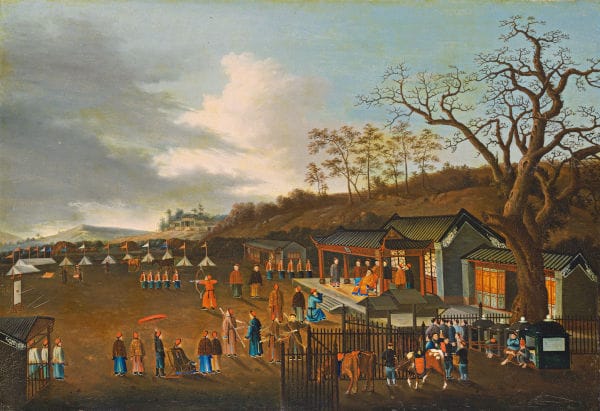
A man who maintained his dignity, followed the rituals precisely, and accepted defeat with grace was deemed fit for leadership and high office. Conversely, those who showed anger, arrogance, or poor form revealed a flawed character, regardless of how many arrows found the target.
Through Sheyi, ancient China successfully merged the martial with the scholarly. The bow became an instrument not just for defending the state, but for refining the individual. This enduring tradition perfectly illustrates the classical Chinese belief that true mastery of any physical skill is ultimately a journey toward mastering oneself.
Jiaodi and Shuai Jiao: The Evolution of Chinese Wrestling
Long before the first imperial dynasties, the earliest forms of Chinese wrestling were born from observing the natural world. The ancient term for this grappling art was Jiaodi (角抵), which literally translates to “horn butting.”
According to enduring mythology, the practice originated with Chi You, a legendary tribal leader depicted with a bronze head and ox-like horns. Early practitioners imitated wild oxen locking horns to test their physical strength, eventually transforming this primal display into a structured contest of human power and technique.
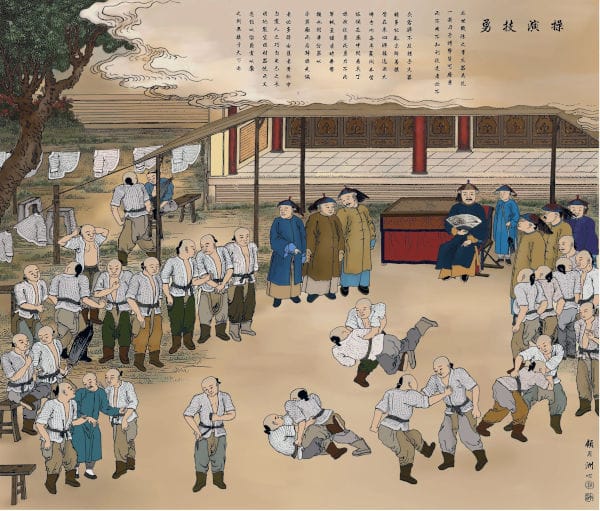
By the Qin (221–206 BCE) and Han (206 BCE–220 CE) dynasties, Jiaodi had evolved into a highly organized practice serving a dual purpose. On the battlefield, it was a vital component of military conditioning, training soldiers in the hand-to-hand combat skills necessary for close-quarters survival.
Off the battlefield, it became a spectacular form of court entertainment. Emperor Wu of the Han Dynasty famously hosted grand wrestling exhibitions to awe visiting foreign dignitaries. These massive events showcased the physical prowess of the empire, blending athletic competition with theatrical performance.
As centuries passed, the nature of the sport refined, shifting away from its mythological animal imitations toward sophisticated human grappling. The practice eventually became widely known as Shuai Jiao (摔跤), a name that highlights its core mechanics: shuai means to throw, and jiao refers to the legs or tripping.
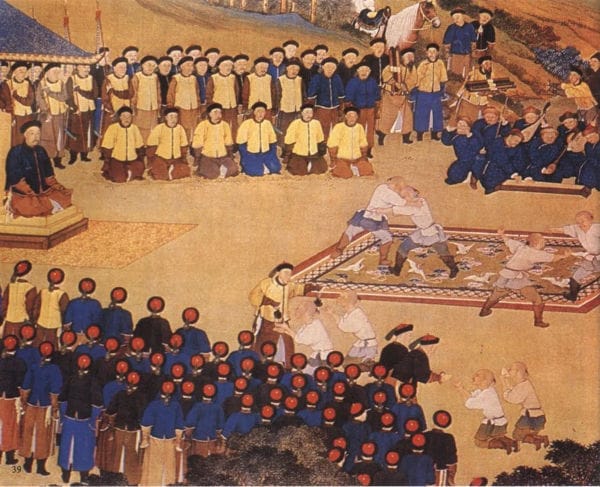
Unlike striking arts that focus on punches and kicks, Shuai Jiao emphasizes leverage, balance, and joint manipulation. Practitioners learn to use an opponent’s momentum against them, executing precise throws and sweeps to bring them to the ground.
This emphasis on technique over brute strength made Shuai Jiao a foundational pillar for the broader development of Chinese martial arts. It taught fighters how to close the distance, control an opponent’s center of gravity, and neutralize attacks without relying solely on physical size.
Today, Shuai Jiao remains a vibrant competitive sport and a living link to antiquity. It preserves the ancient Chinese understanding that true physical mastery lies not just in raw power, but in the intelligent application of technique and balance.
Wushu: From Battlefield Survival to Cultural Heritage
Long before it became a celebrated performance art, Chinese martial arts were born from the harsh realities of early human survival. During the Bronze Age (approximately 3000–1200 BCE), ancient peoples developed rudimentary hand-to-hand combat techniques and weapon skills to hunt wild beasts and defend their tribes. These raw, practical strategies for survival laid the physical foundation for a complex martial system that would eventually span the entire globe.
As Chinese civilization matured, these combat techniques absorbed the profound philosophical currents of the culture. Wushu (武术), literally translating to “martial art,” ceased to be solely about defeating an enemy in battle; it became a holistic path to spiritual and physical harmony.
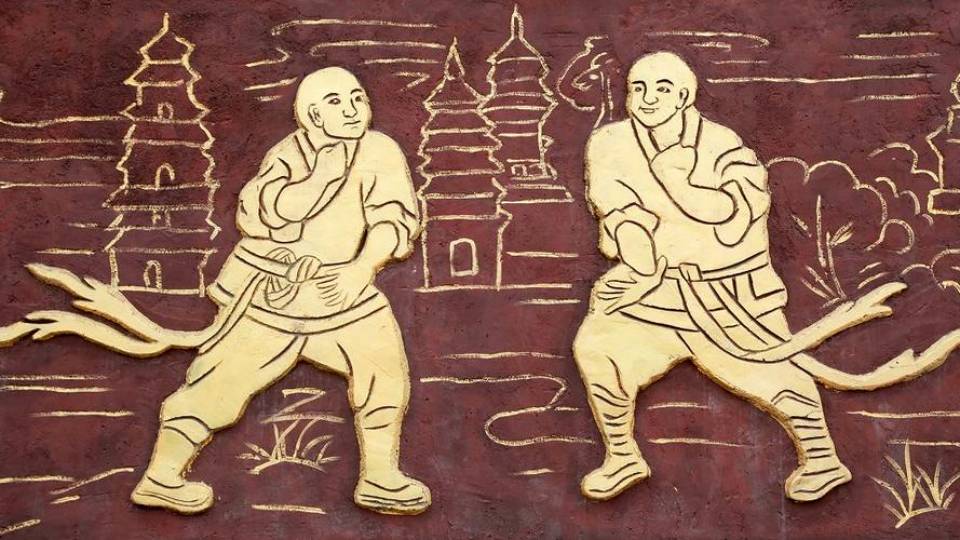
Daoist principles of yielding, fluidity, and balancing Yin and Yang gave rise to “internal” styles, such as Tai Chi, which focus on redirecting an opponent’s force rather than meeting it with brute strength.
Meanwhile, Buddhist influences, most famously associated with the legendary Shaolin Temple, emphasized rigorous discipline, meditation, and the unity of mind and body. This integration created “external” styles renowned for their explosive power, agility, and demanding physical conditioning.
When discussing Wushu today, it is important to distinguish between traditional martial arts and the modern, standardized sport. For centuries, traditional martial arts were passed down through specific lineages, deeply rooted in self-cultivation, moral education, and local philosophy.
However, following the establishment of the People’s Republic of China in 1949, the government systematized these diverse practices into a unified, competitive sport. Modern competitive Wushu is a spectacular, highly regulated athletic event featuring choreographed forms (Taolu) and full-contact sparring (Sanda).
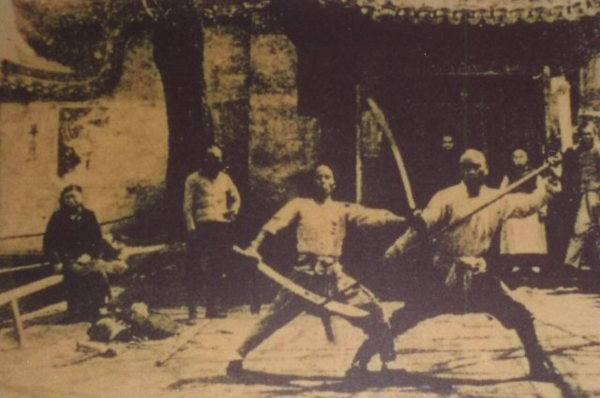
While traditional martial arts preserve the ancient philosophical heritage, modern Wushu showcases the athletic evolution of these practices on the international stage.
Ultimately, Wushu represents the profound synthesis of China’s physical and intellectual history. It transformed the brutal necessities of ancient warfare into a refined cultural heritage, teaching practitioners across generations that the ultimate goal of martial training is not just to conquer others, but to master oneself.
Polo (Jiju): The Elite Sport of the Tang Dynasty
While many ancient Chinese sports evolved organically from local military drills or folk rituals, polo arrived on horseback from afar. Known in ancient China as Jiju (击鞠) or “striking the ball,” the sport was introduced via the Silk Road, carrying with it the equestrian traditions of Persia and Central Asia. By the time it reached the Chinese heartland, it had already captured the imagination of the elite, setting the stage for its golden age.
The Tang Dynasty (618–907 CE) transformed polo into the ultimate aristocratic obsession. For the Tang emperors and their courts, the sport was much more than a pastime; it was a vital way to maintain the martial vigor and horsemanship required to rule a vast empire.
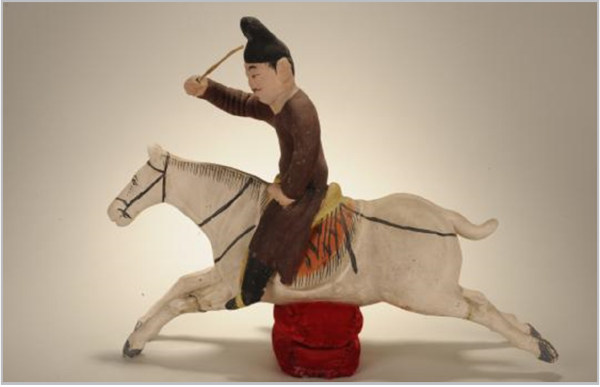
The capital city of Chang’an featured dedicated, meticulously maintained polo fields where nobles and military officials gathered to compete. Because owning and training high-quality horses was incredibly expensive, playing polo became a conspicuous display of wealth, power, and social status.
One of the most remarkable aspects of Tang Dynasty polo was the active participation of women, reflecting the unusually high social status and freedom enjoyed by women during this cosmopolitan era.
Historical records and vivid tomb murals, such as those found in the tomb of Princess Yongtai, depict female nobles and palace maids galloping across the field with mallets in hand. To reduce the risk of severe injury, some women played a variation called lüju, riding sturdy donkeys instead of horses, though the competitive spirit and skill required remained just as fierce.
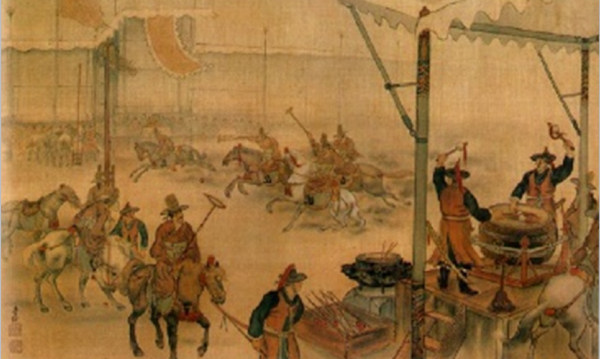
Despite its glamour, polo was a fiercely dangerous game. Players risked broken bones and even death from trampling horses or rogue mallets, earning it a reputation as a sport for the brave. Yet, this very danger and the sheer spectacle of the game perfectly encapsulated the spirit of the Tang Dynasty.
It was a wealthy, dynamic, and outward-looking empire that eagerly embraced foreign influences and celebrated physical excellence. Through the thundering hooves on the polo fields of Chang’an, the Tang elite showcased not just their athletic prowess, but the boundless confidence of a golden age.
Dragon Boat Racing: Ritual, Teamwork, and Folk Tradition
Long before it became a global sport, dragon boat racing was deeply rooted in the agrarian rhythms of southern China. The fifth lunar month marked the beginning of summer, a time historically associated with the spread of diseases and evil spirits.
Ancient communities in the Yangtze River region developed boat racing as a vital ritual to appease river dragons, ensure favorable weather, and secure a bountiful harvest. The rhythmic beating of drums and the splashing of oars were believed to ward off malevolent forces and purify the water.
Over time, these ancient agricultural rituals merged with one of the most enduring legends in Chinese history: the story of Qu Yuan. During the Warring States period, Qu Yuan, a loyal minister and celebrated poet of the State of Chu, drowned himself in the Miluo River in despair over his country’s corruption.
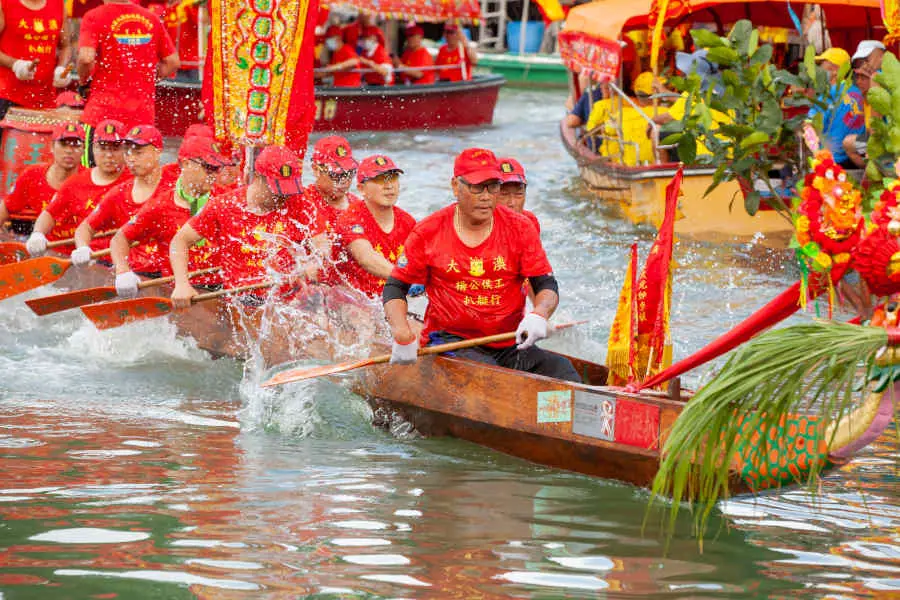
According to legend, local villagers raced their boats out to save him, beating drums and splashing the water to keep fish and evil spirits away from his body. This tragic tale infused the sport with profound patriotic symbolism, transforming a seasonal folk custom into the central event of the Dragon Boat Festival.
The physical execution of dragon boat racing demands extraordinary synchronization. A traditional boat is carved to resemble a Chinese dragon, featuring an ornate head at the bow and a tail at the stern. It requires a drummer at the front to set the pace, a steersman at the back to guide the vessel, and a crew of paddlers whose strokes must move as one.
This absolute reliance on collective effort mirrors the traditional Chinese cultural emphasis on harmony and community over individual glory. Today, this ancient tradition has transcended its regional roots, evolving into a rapidly growing international competitive sport that brings the spirit of unity to waterways across the globe.

Related reading: Innovation Through the Ages: Unraveling the Timeline of Chinese Inventions – Opens in new tab
End Words
The journey through China’s sporting history reveals a profound truth: physical activity was rarely just about physical exertion. Whether it was the meditative focus of an archer, the fluid grace of a martial artist, or the synchronized power of dragon boat paddlers, these practices were designed to cultivate harmony. They bridged the gap between the mind and the body, while simultaneously reinforcing the social bonds and moral values that held communities together. In ancient China, to play a game was to practice the art of living well.
Today, the echoes of these ancient traditions are louder than ever. Dragon boat racing has transformed from a local river ritual into a vibrant international festival celebrated on waterways across the globe. Millions of people practice Tai Chi and modern Wushu daily, seeking the same balance of physical health and mental peace that their ancestors pursued.
Even the global game of football acknowledges its roots in the dusty courtyards of ancient Linzi. These historical practices are not mere relics confined to museums; they are living, breathing elements of modern culture.
Ultimately, the history of sports in China is a testament to a civilization that viewed the human body as a vessel for cultural and philosophical expression. By preserving and sharing these timeless traditions, we do more than celebrate athletic achievement. We keep alive a profound legacy that continues to inspire movement, mindfulness, and unity across the modern world.
| Topic | Source Title | Publisher / Institution | Link |
| Cuju (Ancient Football) | Origins – Cuju in China | FIFA Museum | View Source www.fifamuseum.com |
| Sheyi (Traditional Archery) | Archery Rites: Remaking Confucian Rites | Springer Nature (Academic) | View Source link.springer.com |
| Jiaodi / Shuai Jiao (Wrestling) | Shuai Jiao: Traditional Chinese Wrestling | Atlas of Heritage | View Source www.atlasofheritage.com |
| Wushu (Martial Arts) | History of Wushu | International Wushu Federation (IWUF) | View Source www.iwuf.org |
| Jiju (Tang Dynasty Polo) | Polo: A Cultural Code for Understanding the Silk Road | Korea Science (Academic Journal) | View Source koreascience.kr |
| Dragon Boat Racing | Dragon Boat Festival | UNESCO Intangible Cultural Heritage | View Source ich.unesco.org |
Stay in Touch
 Join our newsletter by using the forms on this website or click here!
- Follow us on Google News
- Follow us on Facebook