
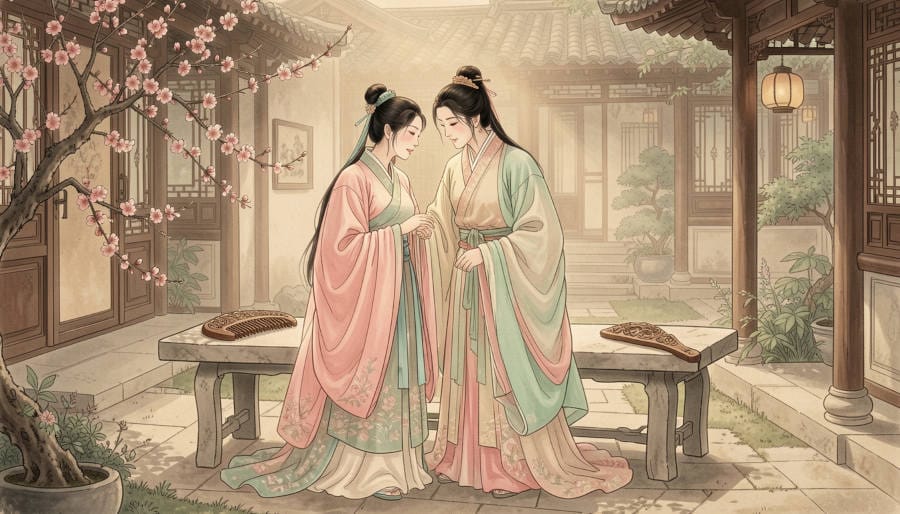
Many people assume that same-sex relationships are a modern phenomenon or a Western import to Asian cultures. However, the history of homosexuality in China stretches back over two millennia. Long before modern LGBTQ terminology existed, ancient Chinese emperors, scholars, and everyday people documented their same-sex affections openly, weaving them into the very fabric of the empire’s cultural and social life.
Unlike the rigid, often punitive religious frameworks seen in some Western histories, ancient Chinese society generally viewed same-sex desire through a more pragmatic and philosophical lens. It was rarely seen as a strict, exclusive identity that inherently conflicted with one’s duty to marry and produce heirs.
Instead, same-sex relationships were frequently viewed as a natural variation of human pleasure and emotional connection. This nuanced perspective allowed same-sex affections to comfortably coexist with traditional heterosexual marriages, giving rise to a rich cultural tapestry of romantic idioms, classical literature, and dedicated social spaces.
In this comprehensive guide, we will journey through the fascinating evolution of same-sex love in Chinese history. We will explore the legendary imperial romances that birthed classical idioms like the “cut sleeve,” uncover the hidden world of female sworn sisterhoods and the secret Nüshu script, and examine the dramatic legal and social shifts during the Qing dynasty.
Finally, we will trace the path from historical erasure to the vibrant, complex realities of the modern Chinese LGBTQ+ community, revealing a history that is as resilient as it is profound.
The Ancient Foundations: Emperors, Idioms, and the Han Dynasty
In early Chinese history, same-sex affection was not defined by modern concepts of exclusive sexual identity, nor was it condemned by strict religious dogmas.
Instead, it was largely viewed as a natural variation of human desire. As long as a man fulfilled his Confucian duties to marry and produce male heirs, same-sex relationships were not only tolerated but often celebrated as a refined expression of personal affection among the elite.
This pragmatic acceptance is beautifully illustrated by one of the earliest and most famous historical anecdotes: the “Shared Peach” (餘桃之癖, Yú Táo Zhī Pǐ). According to ancient texts, Mi Zixia, a favored official of Duke Ling of Wei during the Spring and Autumn period, was eating a peach in an orchard.
Finding it exceptionally sweet, he offered the remaining half to the Duke. Rather than being offended by the breach of etiquette, Duke Ling was deeply moved by the gesture, praising Mi Zixia for sharing his sweetness. This story highlights how same-sex intimacy was comfortably woven into the social fabric of the aristocracy.
By the Han Dynasty, same-sex romance had left an even more profound mark on the cultural lexicon, giving rise to China’s most enduring idiom for male homosexuality: the “Cut Sleeve” (斷袖之癖, Duàn Xiù Zhī Pǐ).
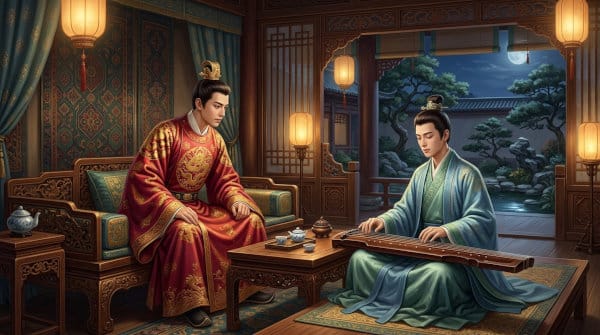
Emperor Ai of Han was famously devoted to his male companion, Dong Xian. The Book of Han records that one morning, the Emperor needed to rise, but Dong Xian was still fast asleep, lying heavily on the Emperor’s sleeve.
Unwilling to wake his lover, Emperor Ai quietly drew his sword and cut off his own sleeve. This act of tender restraint became immortalized in Chinese literature and language as the ultimate symbol of same-sex devotion.
These legendary stories and the idioms they spawned reveal a fascinating aspect of antiquity. Same-sex relations were documented as genuine emotional bonds rather than moral failings. This relatively open and tolerant societal attitude during the Han Dynasty laid a crucial cultural foundation, allowing homoerotic themes to flourish in literature, poetry, and art in the centuries that followed.
The Golden Age of Homoerotic Culture: Tang, Song, and Ming Dynasties
If the Han dynasty gave China its vocabulary for same-sex love, the centuries that followed turned that vocabulary into a living culture. Between the Tang (618–907) and the Ming (1368–1644), male homoeroticism moved from court anecdote into poetry, fiction, theater, and urban nightlife, becoming an unremarkable part of elite social life.
Tang Dynasty: Cosmopolitan Openness at Court
Tang China was confident, wealthy, and deeply connected to Central Asia and the Silk Road. That openness extended to matters of desire, and same-sex affection appeared in court records without the tone of scandal later centuries would adopt.
The most telling example involves Li Chengqian, crown prince of Emperor Taizong. Historical records describe his devotion to a young palace musician named Chengxin. When Taizong learned of the relationship, he had Chengxin executed. His son’s response was extraordinary: the crown prince openly mourned him, erected a memorial statue and tomb within the palace grounds, and honored him posthumously. Grief, not shame, is what the sources preserve.
Tang poetry handled the subject more subtly. Poets wrote of beautiful youths, parting cups, and intimate friendship in language that blurred the line between camaraderie and romance, trusting readers to understand the emotional register.
Song Dynasty: Pleasure Quarters and Vernacular Storytelling
The Song era (960–1279) shifted the center of gravity from palace to city. Kaifeng and Hangzhou boomed with entertainment districts, teahouses, and performance venues, and male entertainers and prostitutes became a visible part of that economy. Zhou Mi’s miscellany Guixin Zashi describes men in Hangzhou who wore cosmetics and women’s dress and worked the pleasure quarters.
Just as importantly, the rise of vernacular storytelling brought same-sex desire into popular literature. Hong Mai’s vast collection Yijian Zhi (“Records of the Listener”) includes matter-of-fact anecdotes about male relationships among officials, merchants, and monks. Song authorities occasionally regulated male prostitution, but their concern was public commerce and disorder, not private affection between consenting men.
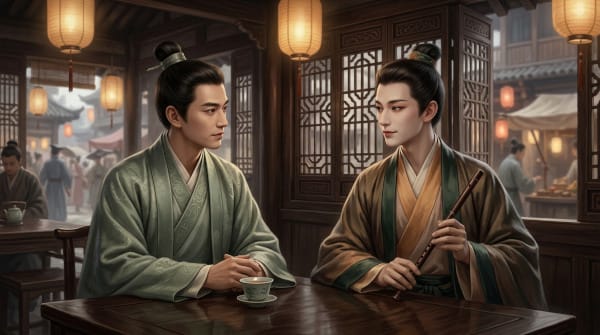
Ming Dynasty: The High Point of Male Homoerotic Culture
The late Ming produced the most abundant documentation of male same-sex relationships in Chinese history, driven by urban wealth, a printing boom, and a literary fascination with qing (情), authentic emotion.
Fujian’s sworn-brother unions. The scholar Shen Defu recorded in his Wanli Yehuo Bian (1606) that Fujian men formed formal unions known as qixiongdi (契兄弟), or “contract brothers.” Families exchanged betrothal gifts, the older partner took responsibility for the younger, and when the younger man eventually married a woman, his former partner often helped fund the wedding. Outside observers, Shen Defu noted, treated these arrangements as ordinary local custom.
A publishing wave of male romance. Feng Menglong devoted an entire chapter of his anthology Qingshi (“History of Love”) to male-male passion, placing it alongside heterosexual romance as equally worthy of literary attention. Novellas such as Bian Er Chai went further, telling male love stories that end in reunion and happiness rather than punishment, while Longyang Yishi explored the commercial underworld of young male courtesans.
Theater and the dan tradition. In Beijing and the Jiangnan cities, male actors who specialized in female roles (dan) attracted devoted followings among officials and merchants. Admiration for a performer’s artistry and beauty overlapped freely, and patronage of actors became a recognized form of social display.
Elite Refinement Versus Everyday Reality
For literati, homoerotic taste functioned as a marker of sophistication. The essayist Zhang Dai listed his youthful love of beautiful boys alongside fine food, music, and clothing in his own self-written epitaph, treating it as one indulgence among many rather than a defining secret.
Yet the record is uneven. Most surviving sources were written by educated men about their own circles, and many relationships involved servants, actors, or prostitutes whose bargaining power was limited. Scholarly affection and commercial exploitation coexisted, sometimes within the same household. And because these documents were written by men about men, an entire parallel world of female intimacy remained largely outside the written record.
The Hidden History: Female Same-Sex Relations and the “Laotong” Tradition
While the romantic affairs of emperors and scholars were frequently documented in official histories, the intimate lives of women in ancient China were largely confined to the nei (内), or inner chambers, of the household.
Because traditional Chinese historiography was dominated by male scholars, female same-sex relations were rarely recorded as explicit romantic or sexual partnerships. Instead, they were often framed as profound “sisterhoods” or intense emotional bonds.
However, modern academic research, such as Tze-Lan D. Sang’s foundational work The Emerging Lesbian, reveals that these relationships provided vital spaces for female autonomy, emotional fulfillment, and sometimes, lifelong romantic partnership.
The “Comb Sisters” (自梳女, Zìshūnǚ) of Guangdong
One of the most remarkable examples of female independence and same-sex partnership in Chinese history is the tradition of the Zìshūnǚ, or “Comb Sisters,” which flourished in the Pearl River Delta region of Guangdong during the late Qing dynasty and the early Republic of China.
As the regional silk industry boomed, many young women found employment in silk filatures, granting them unprecedented economic independence. Unwilling to submit to the patriarchal constraints of arranged marriages, these women chose to remain unmarried.
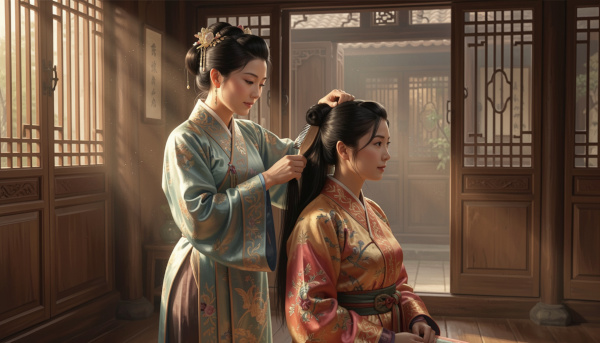
To formalize their decision, they underwent a coming-of-age ritual where they combed their own hair into the traditional bun of a married woman. This symbolic act signified that they were “wedded” to their own independence and vowed lifelong celibacy from men.
Many Comb Sisters lived together in communal residences known as gūpó wū (姑婆屋), or “spinster houses.” Within these spaces, women formed deeply committed, lifelong domestic partnerships. They supported each other financially, cared for one another in illness and old age, and even arranged posthumous adoption rituals to ensure they would receive proper ancestral rites.
For the Comb Sisters, these bonds were not merely practical arrangements; they were profound, chosen families built on mutual devotion.
Nüshu (女書) and the Bonds of “Laotong”
Further inland, in the mountainous Jiangyong County of Hunan province, women developed an entirely different method of preserving their intimate bonds: Nüshu (女書), literally “women’s script.”
Recognized by linguists as the world’s only writing system created and used exclusively by women, Nüshu was a phonetic script derived from local Chinese characters but adapted to the local dialect.
This secret script was the lifeblood of the lǎotóng (老同, “old same” or “sworn sister”) tradition. In a society where women were often isolated in their husband’s villages after marriage, young girls would be paired as laotong based on their birth dates, horoscopes, and personalities. This pairing was meant to last a lifetime.
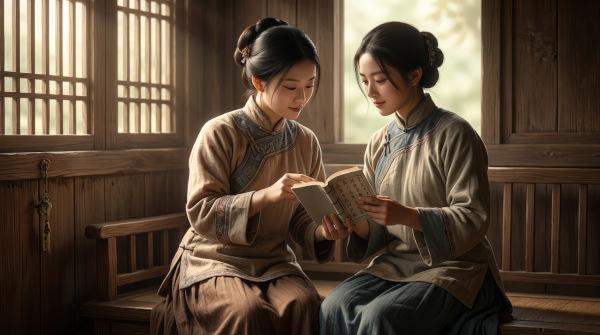
Through laotong relationships, women exchanged embroidered fans, cloth books, and letters written in Nüshu. These texts contained original poetry, autobiographical reflections, and expressions of deep emotional longing and devotion.
While modern scholars debate the extent to which these relationships were explicitly sexual, there is no doubt that they served as a vital, private sanctuary for female emotional and romantic intimacy, entirely shielded from the male gaze.
The famous novel and subsequent film Snow Flower and the Secret Fan brought global attention to this beautiful, albeit historically marginalized, tradition.
Decoding Female Desire in Historical Records
Understanding female same-sex relations in Chinese history requires a shift in how we read historical texts. As historian Tze-Lan D. Sang points out, applying modern Western labels like “lesbian” to pre-modern Chinese women can be anachronistic. In traditional Chinese society, a woman’s primary social value was tied to her roles as a daughter, wife, and mother.
Consequently, intense emotional and physical intimacy between women was often tolerated or overlooked by the patriarchal system precisely because it was not viewed as a direct threat to male lineage—unlike male homosexuality, which could be seen as diverting male attention away from procreation. Female desire was expressed through the language of extreme loyalty, poetic metaphors of intertwined branches, and shared domestic lives.
By looking beyond official dynastic records and examining folk traditions, women’s literature, and regional customs like the Comb Sisters and Nüshu, we can uncover a rich, resilient tapestry of female love. This hidden history proves that even within the strict confines of imperial patriarchy, Chinese women found ingenious ways to forge deep, lasting, and authentic connections with one another.
Related Reading: The Untold Story of China’s Imperial Eunuchs: From Punishment to Power – Opens in new tab
The Turning Point: The Qing Dynasty and the Shift Toward Taboo
While the Ming dynasty represented a high point of cultural visibility for same-sex relations, the Qing dynasty (1644–1912) marked a dramatic turning point. Over the course of this final imperial era, homosexuality shifted from a tolerated aristocratic indulgence to a legal crime, and eventually, a profound social taboo.
This transition was driven by a combination of internal legal reforms, strict social conservatism, and the eventual influx of Western ideologies.
The Qianlong Emperor’s Legal Crackdown
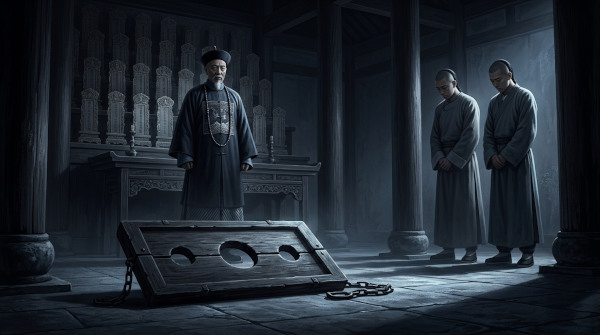
The most concrete shift occurred in 1740, during the reign of the Qianlong Emperor. The Qing legal code was revised to explicitly criminalize consensual same-sex sodomy. Previously, Chinese laws primarily focused on punishing non-consensual acts or maintaining public order.
The new edict, however, equated consensual male same-sex acts with severe crimes, punishing offenders with a month in a cangue (a heavy wooden pillory worn around the neck) and a hundred blows with a heavy bamboo stick.
While historical records suggest this law was not always strictly enforced at the local level, its mere existence sent a powerful message. The state no longer viewed same-sex relations as a harmless private matter or a refined elite pastime, but as a punishable offense against public morality.
The legal safety net that had protected same-sex couples for centuries was effectively dismantled.
Neo-Confucianism and the Pressure of Lineage
Parallel to these legal changes was a deepening social conservatism rooted in orthodox Neo-Confucianism. During the Qing dynasty, the imperative to produce male heirs and maintain strict patrilineal family hierarchies reached its zenith. The ancient Confucian warning that “there are three ways to be unfilial, and having no heir is the worst” became an inescapable social mandate.
Because same-sex relations inherently could not produce offspring, they were increasingly viewed through a harsher moral lens. The societal focus shifted from the nature of the affection to its utility.
Same-sex desires were pushed out of the public eye and into the shadows, as men faced immense familial pressure to marry and fulfill their reproductive duties. What was once celebrated in literature as a passionate bond was now quietly dismissed as a frivolous distraction from one’s sacred duty to the ancestors.
Related reading: The Most Powerful Women in Ancient China – Opens in new tab
The Late Qing: Victorian Morality and Medical Pathologization
The final blow to the historical acceptance of homosexuality arrived in the 19th and early 20th centuries with the influx of Western influence. Following the Opium Wars, China was forced to open its ports, bringing with them Western missionaries, diplomats, and medical professionals who carried the strict moral codes of the Victorian era.
To the Victorians, homosexuality was viewed not just as a sin, but as a profound moral and psychological deviance. As Chinese intellectuals and reformers desperately sought ways to modernize and strengthen their nation against Western imperialism, they often looked to the West for models of “civilized” behavior.
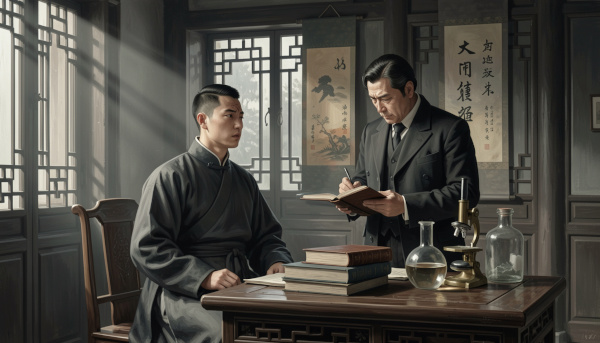
Consequently, many adopted Western medical and psychological frameworks that pathologized same-sex desire. Homosexuality was reclassified from a traditional moral failing into a “modern” mental illness or a sign of national weakness.
This imported stigma laid the tragic groundwork for the severe marginalization that the LGBTQ+ community would face in the 20th century.
The Modern Era: From Erasure to the Contemporary LGBTQ+ Movement
The transition into the 20th century was highly turbulent for same-sex relations in China. While the early Republic era saw brief intellectual curiosity and early sociological studies regarding sexuality, the mid-century brought profound erasure.
During the Cultural Revolution (1966–1976), the state heavily policed private lives, and any deviation from strict socialist norms was heavily scrutinized.
Same-sex relationships were entirely erased from public discourse and could be prosecuted under the broad, vaguely defined legal charge of “hooliganism” (流氓罪, liúmáng zuì). For decades, homosexuality was forced deep underground, and a distinct public queer identity was virtually non-existent.
The turning point for the modern Chinese LGBTQ+ community arrived at the dawn of the 21st century, marked by two monumental legal and medical milestones. In 1997, the revision of the criminal code effectively decriminalized same-sex relations by removing the “hooliganism” clause.
Then, in 2001, the Chinese Psychiatric Association officially removed homosexuality from its classification of mental illnesses. These dual victories laid the essential groundwork for contemporary queer rights, allowing the community to begin organizing and advocating for visibility.
Today, China is home to a vibrant, digitally connected LGBTQ+ community, yet its members navigate a unique cultural tightrope. The central conflict is not necessarily legal, but deeply cultural: the ancient Confucian virtue of filial piety (孝, xiào).
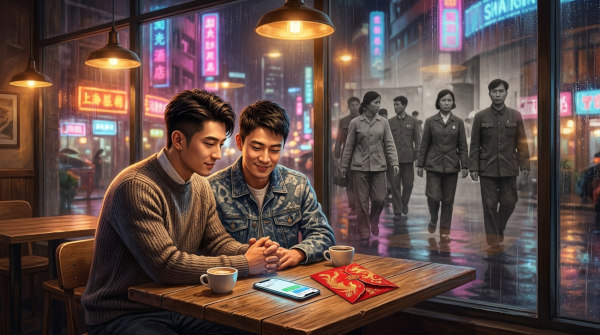
The traditional mandate to marry, produce heirs, and care for aging parents remains a powerful social force. To reconcile their authentic identities with these immense familial expectations, many modern queer individuals have developed ingenious social strategies.
One of the most fascinating modern phenomena is the rise of “contract marriages” (形婚, xínghūn). In these pragmatic arrangements, a gay man and a lesbian formally marry each other to present a traditional heterosexual front to their families and society, while privately maintaining their own same-sex relationships and lives.
While this strategy solves the immediate pressure of filial duty and social scrutiny, it also highlights the ongoing struggle to find full, unapologetic societal acceptance.
Despite facing ongoing internet censorship and societal hurdles, the modern Chinese LGBTQ+ movement continues to grow and adapt. By drawing on the quiet resilience of their ancestors, contemporary queer individuals are forging new paths, blending ancient cultural values with modern identities in a rapidly changing society.
End Words
The history of homosexuality in China is far from a modern import or a simple tale of historical oppression. From the tender devotion of the “cut sleeve” in the Han dynasty to the resilient sisterhoods of the Comb Sisters and the vibrant digital communities of today, same-sex love has been a persistent thread in the cultural tapestry.
It survived imperial edicts, shifting social norms, and centuries of silence, proving that the desire for authentic connection is a universal human constant.
Unearthing this hidden history does more than just correct the historical record; it provides a vital bridge between ancient traditions and modern LGBTQ+ identities.
When we recognize that queer love has always existed within the framework of Chinese culture, we dismantle the persistent myth that it is a foreign concept. This historical continuity offers profound comfort and validation to modern individuals navigating the complex intersection of traditional family expectations and personal authenticity.
We would love to hear your thoughts on this journey through history. Which historical figure, idiom, or tradition surprised you the most? Please share your insights in the comments below, ask any questions you have about Chinese cultural history, and share this article with friends who are passionate about uncovering the diverse stories of the past.
Curious to learn more about Homosexuality in Chinese History?
Expand your knowledge with our top recommended reads (Aff-links):
Further reading
| Source / Book Title | Author(s) | Why It Is Valuable | Where to Find It |
| Passions of the Cut Sleeve: The Male Homosexual Tradition in China | Bret Hinsch | The definitive English-language academic text on male same-sex traditions, tracing the history from ancient imperial courts to the Qing dynasty. | University of California Press |
| The Emerging Lesbian: Female Same-Sex Desire in Modern China | Tze-Lan D. Sang | A groundbreaking exploration of female same-sex desire, examining how women’s intimate relationships evolved from the late imperial period into the modern era. | University of Chicago Press |
| Homoerotic Sensibilities in Late Imperial China | Wu Cuncun | Provides a deep, nuanced look at the flourishing of male homoerotic culture, literature, and theater during the Ming and Qing dynasties. | Routledge |
| Queer China: Lesbian and Gay Literature and Visual Culture Under Postsocialism | Hongwei Bao | Analyzes the modern LGBTQ+ movement, digital culture, and the complex navigation of contemporary queer identities in a rapidly changing China. | Routledge |
| Snow Flower and the Secret Fan | Lisa See | While this is a historical novel rather than an academic text, it beautifully and accurately illustrates the laotong tradition and the secret Nüshu script used by women in Hunan. | Simon & Schuster |
| Epistemic Modernity and the Emergence of Homosexuality in China | Howard Chiang | A vital academic paper exploring how the modern Western concept of sexual identity was translated, constructed, and adapted within Chinese society in the early 20th century. | Wiley Online Library (Gender & History) |
Stay in Touch
 Join our newsletter by using the forms on this website or click here!
- Follow us on Google News
- Follow us on Facebook