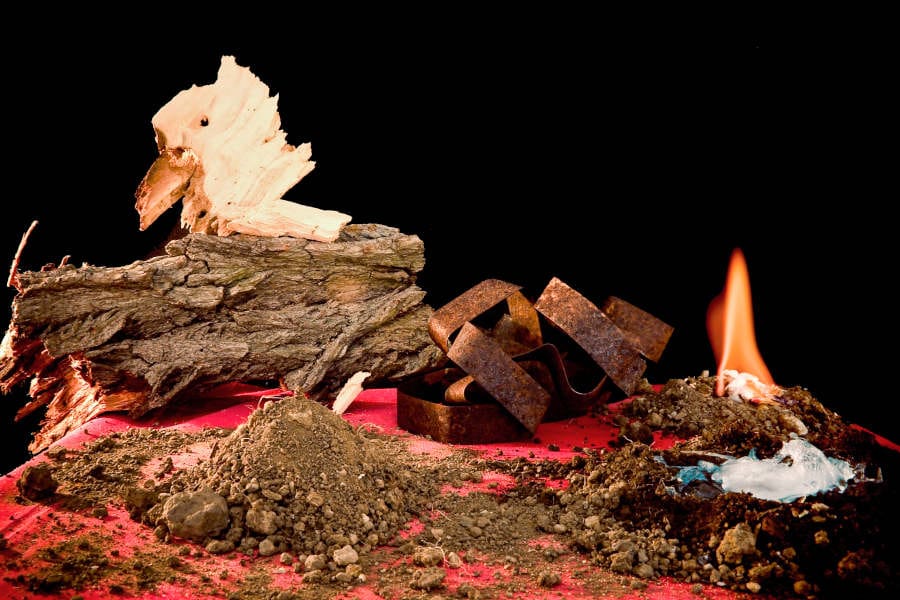
Have you ever noticed how your energy shifts with the changing seasons, or why a particular color or flavor seems to calm your mind after a long day? In traditional Chinese thought, these are not random occurrences. They are subtle reflections of a centuries-old framework that views human health as a living mirror of the natural world: Wu Xing, commonly known as the Five Elements.
Rather than treating the body as a machine made up of separate parts, ancient Chinese scholars observed how everything moves in cycles. Wood, Fire, Earth, Metal, and Water are not static materials but dynamic phases of transformation that continuously nourish, regulate, and balance one another.
Within Traditional Chinese Medicine (TCM), these phases correspond directly to specific organ networks, emotional patterns, seasonal rhythms, and even the colors we naturally gravitate toward. By learning to recognize these connections, you can understand your body’s signals more clearly and make simple, everyday choices that support lasting vitality.
This guide will walk you through each phase, reveal how their interactions shape health and mood, and show you how to align your daily routines with nature’s rhythms. Let’s explore a timeless approach to wellness—one that treats balance not as a fixed goal, but as a dynamic, lifelong conversation between your body and the world around you.
Historical Origins and Philosophical Roots
The concept of Wu Xing (五行) dates back more than three thousand years in Chinese thought, with its earliest recorded appearance in the Shang Shu (Book of Documents), specifically the “Hong Fan” chapter. During the Western Zhou dynasty, scholars began observing patterns in nature—seasonal shifts, agricultural cycles, and celestial movements—and sought to organize these rhythms into a coherent framework.
By the Warring States period, the philosopher Zou Yan of the Yin-Yang School expanded Wu Xing into a sophisticated cosmological system, linking it to dynastic change, geography, and human affairs.
Later, Han Dynasty thinkers such as Dong Zhongshu integrated Wu Xing with Confucian ethics and Yin-Yang theory, cementing its role as a cornerstone of Chinese natural philosophy. Rather than emerging from abstract speculation, Wu Xing developed through careful observation of how the world moves, transforms, and sustains balance.
The Concept of Dynamic Phases Over Static Substances
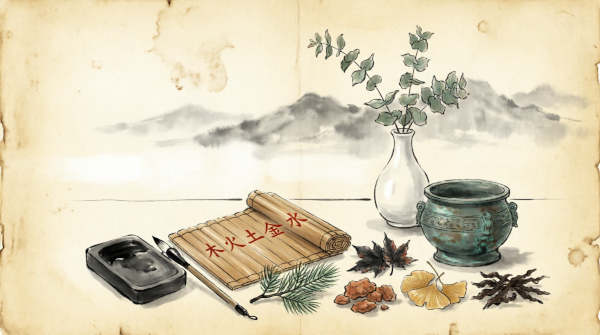
Although often translated as the “Five Elements,” a more accurate rendering of Wu Xing is “Five Phases” or “Five Movements.” This distinction is important.
Unlike the classical Greek elements—which describe static substances—Wu Xing captures dynamic processes: Wood represents upward growth and expansion; Fire symbolizes flourishing and ascending energy; Earth embodies stabilization and nourishment; Metal reflects contraction and refinement; Water signifies downward flow and storage.
These phases are not isolated materials but interrelated processes in constant transformation. Think of them less as building blocks and more like seasons in a year: each gives rise to the next, each moderates another, and together they create the rhythm of life. This fluid, relational perspective is central to how Traditional Chinese Medicine interprets health—not as fixed states, but as patterns of movement and balance.
How Wu Xing Shapes Traditional Chinese Medical Theory
In Traditional Chinese Medicine (TCM), Wu Xing provides the structural logic that connects the human body to the natural world. Each phase corresponds to specific organ systems—not only as anatomical structures, but as functional networks governing physiology, emotion, and vitality.
For example, the Wood phase links the Liver and Gallbladder to the emotion of anger, the season of spring, and the color green. These associations are not arbitrary; they reflect observed patterns. A person experiencing irritability (anger) in spring might be understood as having an excess of Wood energy, guiding a practitioner toward specific dietary, herbal, or acupuncture strategies.
Wu Xing also explains how organs interact: the Liver (Wood) nourishes the Heart (Fire) in the Generating Cycle, while the Kidneys (Water) prevent the Heart (Fire) from becoming overactive in the Controlling Cycle. This systemic view allows TCM practitioners to diagnose imbalances holistically and restore harmony by working with—not against—the body’s innate rhythms.
The Five Elements and Their Core Correspondences
Wood (Mu): Liver and Gallbladder, Anger, Spring, and Green
In Traditional Chinese Medicine, the Wood phase embodies the energy of new beginnings, flexibility, and purposeful growth—much like a sapling pushing through the soil toward sunlight.
Wood governs the Liver and Gallbladder, organ systems responsible for the smooth flow of Qi (vital energy) and decision-making. When Wood energy is balanced, a person feels decisive, creative, and adaptable. When imbalanced, frustration or irritability may arise, reflecting Wood’s associated emotion: anger.
This connection is not purely metaphorical; TCM observes that chronic anger can strain Liver function, just as Liver Qi stagnation may manifest as moodiness or tension. Wood corresponds to spring, the season of renewal, and the color green, which appears in TCM dietary therapy through leafy greens and sprouts that support Liver health and gentle detoxification.
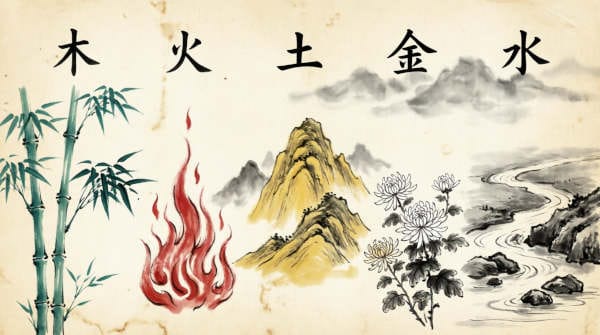
Fire (Huo): Heart and Small Intestine, Joy, Summer, and Red
Fire represents warmth, connection, and vibrant expression—the peak of Yang energy in the natural cycle. In the body, Fire governs the Heart and Small Intestine.
The Heart, revered in TCM as the “Emperor” of the organs, houses the Shen (spirit or consciousness), influencing mental clarity, emotional warmth, and sleep quality. Its paired emotion is joy—not fleeting excitement, but deep contentment and genuine connection.
Excessive joy or agitation, however, can scatter Heart Qi, leading to restlessness or insomnia. Fire aligns with summer, the season of peak activity and social engagement, and the color red.
In practice, red foods such as goji berries, hawthorn, and adzuki beans are used to nourish Heart blood and calm the spirit, while summer routines emphasize moderation to prevent overheating both physically and emotionally.
Earth (Tu): Spleen and Stomach, Worry, Late Summer, and Yellow
Earth symbolizes stability, nourishment, and centeredness—the grounding force that transforms raw materials into usable energy. This phase governs the Spleen and Stomach, the digestive core of TCM physiology.
Unlike in Western medicine, the TCM Spleen is not just an immune organ; it is responsible for “transportation and transformation,” extracting Qi from food and distributing it throughout the body.
When Earth energy is strong, digestion is efficient, muscles are toned, and thinking is clear. When weakened, worry—a ruminative, overthinking emotion—can take hold. Conversely, chronic anxiety may impair digestive function.
Earth corresponds to late summer (or the transitional periods between seasons), a time of harvest and integration, and the color yellow. Foods such as millet, pumpkin, and ginger support Earth energy by warming the digestive system and promoting mental calm.
Metal (Jin): Lungs and Large Intestine, Grief, Autumn, and White
Metal embodies structure, refinement, and release—the energy that condenses and purifies. In the body, Metal governs the Lungs and Large Intestine, organs involved in taking in the new and letting go of the old.
The Lungs receive Qi from air and food, while the Large Intestine eliminates waste; together, they model the cycle of intake and release. Metal’s associated emotion is grief, which, when processed in a healthy way, allows for emotional clarity and renewal.
Unresolved grief, however, can weaken Lung Qi, manifesting as shallow breathing, fatigue, or increased susceptibility to colds. Metal aligns with autumn, the season of letting go, and the color white.
In TCM practice, white foods such as pears, radishes, and lily bulb help moisten the Lungs, support respiratory health, and assist in processing loss during this introspective season.
Water (Shui): Kidneys and Bladder, Fear, Winter, and Black
Water represents depth, wisdom, and potential—the foundational Yin energy that stores essence and sustains life. Water governs the Kidneys and Bladder, with the Kidneys regarded as the “Root of Life” in TCM.
They store Jing (constitutional essence), govern reproduction, growth, and aging, and provide the foundational energy that supports all bodily functions.
Water’s associated emotion is fear; while healthy caution is protective, chronic fear or shock can deplete Kidney Qi, leading to fatigue, lower back weakness, or anxiety. Conversely, weak Kidney energy may make a person more prone to fearfulness.
Water corresponds to winter, the season of rest, conservation, and inner reflection, and the color black (or deep blue). Foods such as black sesame, black beans, and wood ear mushrooms are traditionally used to nourish Kidney Yin and Yang, supporting vitality during the colder months.
| Element | Primary Organs (TCM) | Associated Emotion | Season | Color | Key Nourishing Foods |
| Wood (Mu) | Liver, Gallbladder | Anger (frustration, irritability) | Spring | Green | Sprouts, leafy greens, lemon, chives, celery |
| Fire (Huo) | Heart, Small Intestine | Joy (excess: agitation, restlessness) | Summer | Red | Goji berries, hawthorn, red dates, adzuki beans, tomatoes |
| Earth (Tu) | Spleen, Stomach | Worry (overthinking, rumination) | Late Summer / Seasonal Transitions | Yellow | Millet, pumpkin, sweet potato, ginger, turmeric |
| Metal (Jin) | Lungs, Large Intestine | Grief (sadness, difficulty letting go) | Autumn | White | Pears, radish, lily bulb, almonds, cauliflower |
| Water (Shui) | Kidneys, Bladder | Fear (anxiety, chronic worry) | Winter | Black / Deep Blue | Black sesame, black beans, walnuts, wood ear mushroom, seaweed |
The Cycles of Interaction: How the Elements Connect
The Generating (Sheng) Cycle: Nourishment and Sequential Growth
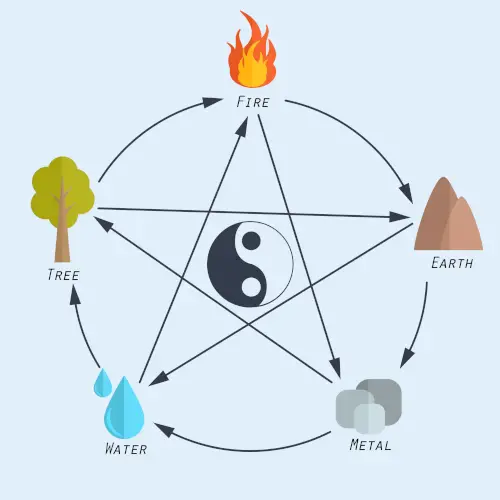
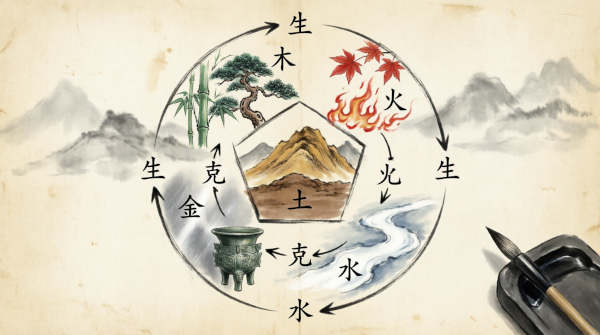
The Generating Cycle, known as Sheng (生), describes how the Five Elements nurture and support one another in a continuous, life-affirming sequence: Wood feeds Fire, Fire creates Earth (through ash), Earth bears Metal, Metal collects Water, and Water nourishes Wood.
This cycle mirrors natural processes—like a tree fueling a flame, or minerals condensing from moisture—and in Traditional Chinese Medicine, it maps how organ systems sustain each other. For instance, the Liver (Wood) stores blood and ensures smooth Qi flow, which supports the Heart’s (Fire) function of circulating blood and housing the spirit.
When this nurturing flow is harmonious, energy moves effortlessly through the body. But if one phase weakens—say, Kidney (Water) essence is depleted—it may fail to nourish the Liver (Wood), potentially leading to symptoms like dry eyes, irritability, or menstrual irregularities. Understanding the Sheng Cycle helps practitioners strengthen deficient organs by supporting their “mother” element, restoring balance through gentle, sequential care.
The Controlling (Ke) Cycle: Balance and Natural Restraint
Complementing the Generating Cycle is the Controlling Cycle, or Ke (克), which ensures no single energy grows excessive. In this balancing loop: Wood parts Earth (as roots break soil), Earth dams Water, Water extinguishes Fire, Fire melts Metal, and Metal cuts Wood.
Far from representing conflict, this cycle reflects nature’s wisdom in maintaining equilibrium—just as winter’s cold restrains summer’s heat. In the body, the Ke Cycle keeps organ functions in check: the Liver (Wood) helps regulate the Spleen (Earth) to prevent dampness and sluggish digestion, while the Kidneys (Water) cool the Heart (Fire) to avoid anxiety or insomnia.
When this restraint functions well, the body adapts smoothly to internal and external changes. However, if one element becomes too strong or too weak, the controlling relationship can falter. For example, chronic stress may cause Liver Qi to overact on the Spleen, resulting in poor appetite or bloating—a common TCM pattern linking emotional tension to digestive discomfort.
Recognizing Overacting and Insulting Cycles in Health
Beyond the standard cycles, TCM identifies two pathological patterns that reveal deeper imbalances: Overacting (Cheng) and Insulting (Wu). Overacting occurs when one element exerts excessive control—like Wood overacting on Earth, where intense anger or Liver Qi stagnation severely impairs Spleen function, causing digestive issues during emotional stress.
Insulting, conversely, happens when the controlled element rebels against its restrainer—such as Earth insulting Wood, where chronic dampness from Spleen deficiency obstructs Liver Qi flow, leading to frustration alongside fatigue.
These patterns aren’t theoretical; they guide precise diagnosis and treatment. A practitioner might address Wood-overacting-on-Earth by soothing the Liver while strengthening the Spleen with herbs like Bai Shao (white peony) and Bai Zhu (atractylodes). Recognizing these dynamic interactions allows TCM to treat not just symptoms, but the relational disharmony beneath them—restoring health by realigning the body’s innate elemental rhythms.
| Cycle Type | Sequence | Natural Metaphor | TCM Organ Relationship | Health Purpose |
| Sheng (Generating) | Wood → Fire | A tree fuels a flame | Liver (Wood) stores blood to support Heart (Fire) function | Ensures emotional warmth and mental clarity arise from smooth Qi flow |
| Sheng (Generating) | Fire → Earth | Ash from fire enriches soil | Heart (Fire) warmth aids Spleen (Earth) digestion and transformation | Supports healthy metabolism and nutrient absorption through circulatory vitality |
| Sheng (Generating) | Earth → Metal | Minerals form within earth | Spleen (Earth) extracts Qi from food to strengthen Lungs (Metal) | Builds robust Wei Qi (defensive energy) and respiratory resilience |
| Sheng (Generating) | Metal → Water | Metal surfaces collect dew | Lungs (Metal) descend Qi to help Kidneys (Water) grasp and store essence | Promotes fluid balance, deep breathing, and conservation of vital essence |
| Sheng (Generating) | Water → Wood | Rain nourishes new growth | Kidneys (Water) provide Jing (essence) to fuel Liver (Wood) planning and growth | Sustains adaptability, vision, and the body’s capacity for renewal |
| Ke (Controlling) | Wood → Earth | Roots break and aerate soil | Liver (Wood) ensures smooth Qi flow to prevent Spleen (Earth) stagnation | Prevents dampness, bloating, and mental fog by keeping digestion dynamic |
| Ke (Controlling) | Earth → Water | Earthen banks guide rivers | Spleen (Earth) transforms fluids to regulate Kidney (Water) metabolism | Prevents edema or dehydration by maintaining healthy fluid distribution |
| Ke (Controlling) | Water → Fire | Water cools an overheating flame | Kidneys (Water) anchor and cool Heart (Fire) to calm the spirit | Protects against anxiety, insomnia, and emotional agitation |
| Ke (Controlling) | Fire → Metal | Heat refines and shapes ore | Heart (Fire) circulation prevents Lungs (Metal) from becoming too constrictive | Supports healthy grief processing and prevents respiratory rigidity |
| Ke (Controlling) | Metal → Water | A blade channels flowing water | Lungs (Metal) descending Qi helps restrain Liver (Wood) from rising excessively | Keeps frustration and irritability in check through clear emotional release |
Applying Wu Xing in Traditional Chinese Medicine
Diagnostic Patterns Through Elemental Observation
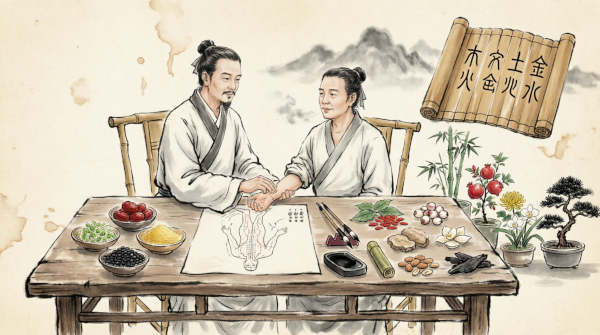
In Traditional Chinese Medicine, diagnosis begins with careful observation, using the Five Elements as a living framework rather than a rigid checklist. Practitioners assess complexion, voice quality, pulse characteristics, tongue appearance, and emotional tendencies to identify which elemental phase is flourishing, struggling, or out of balance.
A greenish or bluish tint around the lips or temples, for instance, often points to Wood and Liver involvement, while a bright red face may signal excess Fire affecting the Heart. Pulse diagnosis deepens this picture: a wiry, taut rhythm typically correlates with Wood stagnation, whereas a rapid, bounding pulse suggests Fire excess. The tongue offers additional insight—a pale, swollen surface with teeth marks frequently reflects Earth and Spleen weakness, while a dry, cracked appearance may indicate Water and Kidney depletion.
By reading these outward signs, practitioners map internal disharmony to specific elemental patterns, allowing them to address the underlying rhythm rather than merely treating isolated symptoms.
Dietary and Lifestyle Adjustments for Seasonal Harmony
Wu Xing teaches that vitality thrives when daily habits move in step with nature’s seasonal cycle. Each element governs a particular time of year, and TCM recommends shifting food choices and routines to nourish the corresponding organs.
Spring (Wood) calls for light, upward-growing foods like bamboo shoots, sprouts, and leafy greens to encourage smooth Qi flow, paired with gentle stretching and early morning walks that mirror the season’s expansive energy.
Summer (Fire) benefits from cooling but not icy foods such as cucumber, mint, and mung beans to protect Heart fluids, along with moderate activity and brief afternoon rests to prevent Yang from burning out. During late summer (Earth), warm, easily digestible meals like congee, sweet potato, and ginger stabilize digestion and ease transitional dampness, while consistent daily routines ground the mind against overthinking.
Autumn (Metal) favors moistening foods like pears, honey, and almonds to support Lung Qi as dry air arrives, complemented by deliberate breathing exercises and earlier bedtimes.
Winter (Water) is the season for conservation: nourishing broths, black sesame, and slow-cooked beans strengthen Kidney essence, while quiet reflection and adequate sleep honor the body’s natural need to store energy for the year ahead.
Emotional Regulation and Organ-Specific Self-Care
Because Wu Xing ties each element to a specific emotion, emotional well-being in TCM is never separated from physical function. Recognizing how feelings influence the organs allows for targeted, practical self-care.
When Wood and the Liver are strained, frustration or irritability may accumulate; practices like yoga, progressive stretching, and constructive communication help release constrained Qi without suppression. For Fire and the Heart, excessive excitement or mental chatter can scatter the Shen; meditation, digital boundaries, and calming infusions like lotus seed or rose petal tea restore inner quiet.
Earth imbalances often surface as chronic worry or rumination; mindful eating, grounding walks in nature, and setting clear mental boundaries help stabilize both digestion and thought patterns. Metal and the Lungs respond to unprocessed grief through breath-focused practices like Qigong or reflective writing, which create safe space for emotional release.
Finally, Water and the Kidneys, easily depleted by fear or prolonged stress, benefit from consistent sleep schedules, gentle lower-back warmth, and routines that build steady resilience rather than quick fixes. By honoring these elemental-emotional connections, individuals can cultivate a balanced inner climate that supports lasting health through every phase of life.
| Season / Element | Recommended Foods | Daily Movement | Mindful Practice | Common Pitfall to Avoid |
| Spring / Wood | Sprouts, leafy greens, lemon, chives, celery, sour flavors | Gentle stretching, morning walks, Qi Gong “Wood” flows | Set clear intentions; practice constructive expression of feelings | Suppressing frustration or pushing too hard before the body is ready |
| Summer / Fire | Cucumber, mint, mung beans, watermelon, red dates, light proteins | Moderate activity in cool hours; swimming; social movement | Short meditation; digital boundaries; heart-opening breathwork | Overstimulation, excessive heat exposure, or scattering energy through too many commitments |
| Late Summer / Earth | Millet, pumpkin, sweet potato, ginger, turmeric, warm cooked meals | Grounding walks in nature; gentle yoga; tai chi | Mindful eating; gratitude journaling; setting mental boundaries | Overthinking, skipping meals, or ignoring transitional fatigue |
| Autumn / Metal | Pears, radish, lily bulb, almonds, honey, white mushrooms | Deep breathing exercises; brisk walks in crisp air; shoulder-opening stretches | Reflective writing; letting-go rituals; practicing gratitude for release | Clinging to past disappointments or ignoring dryness in skin and lungs |
| Winter / Water | Black sesame, black beans, walnuts, bone broth, seaweed, slow-cooked foods | Restorative movement; gentle lower-back stretches; short outdoor walks | Quiet reflection; adequate sleep; conserving energy for renewal | Overexertion, chronic stress, or neglecting rest during the body’s natural conservation phase |
End Words
The Five Elements offer more than an ancient framework for understanding health—they provide a living map of how our bodies, emotions, and environment move together. By recognizing the patterns of Wood, Fire, Earth, Metal, and Water, we learn to listen to our bodies with greater awareness and respond to life’s changes with flexibility and balance.
Whether through seasonal eating, mindful breathing, or simply honoring the natural rhythm of rest and activity, Wu Xing reminds us that wellness is not about fixing isolated parts, but about nurturing the whole system in harmony with nature.
As you explore these principles in your own life, please remember that Traditional Chinese Medicine is designed to complement, not replace, modern healthcare. The information shared here is for educational purposes only and does not constitute medical advice, diagnosis, or treatment.
Always consult a licensed healthcare provider or a certified TCM practitioner before making significant changes to your diet, lifestyle, or wellness routine, especially if you are managing a chronic condition, are pregnant, or are taking prescription medications.
May your journey through the Five Elements bring you greater clarity, resilience, and lasting harmony.
Traditional Chinese Medicine offers a rich, practical approach to understanding your body and supporting your well-being in everyday life.
References & Further Reading
- Huangdi Neijing (Yellow Emperor’s Classic of Internal Medicine), c. 300 BCE – Su Wen Chapters 4 & 5
- Shang Shu (Book of Documents), “Hong Fan” chapter
- Chung, S. et al. (2017). “The five elements of the cell.” Integrative Medicine Research, 6(4), 452–456
- Zhu, R. (2020). “Scientific Connotation of the Five Elements Theory.” OSF Preprints
- Jagirdar, P.C. (1989). “The theory of five elements in acupuncture.” American Journal of Chinese Medicine, 17(3-4), 135–138
*Note: This article is for educational purposes. Consult a licensed TCM practitioner or healthcare provider for personal medical advice.*
Stay in Touch
 Join our newsletter by using the forms on this website or click here!
- Follow us on Google News
- Follow us on Facebook



Featured image from Depositphotos
Share it!